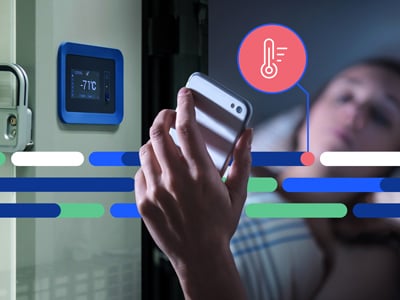
At 2:14 a.m., a lab manager’s phone lights up on the nightstand. A -80 °C freezer is warming, and inside are patient-derived samples that can’t be replaced. She has very little time and four important questions to answer:
- Which unit is it, and what’s inside?
- Is a backup freezer free, and where is it?
- When was this unit last serviced?
- Who needs to know?
The monitoring system did its job and sent the alert, but the four answers are scattered across a shared-drive spreadsheet, a paper log taped to the freezer door, and the memory of a colleague who is asleep across town.
The samples survive. By morning, however, a second clock is running. QA needs a full account of the excursion, the response, and the unit’s service history, pieced together from the same scattered sources.
Anyone who has worked in lab operations knows some version of this story.
How labs got here
Lab operations rarely follow a master plan. They grow along with the asset list. A booking calendar arrives when shared instruments get crowded, a spreadsheet tracks calibration due dates, a maintenance system handles work orders, a monitoring platform watches temperatures, and a quality system holds controlled documents. Each tool solves a real problem, and none of them talks to the others.
So, by default, people become the integration layer. The lab manager in our story did exactly that by cross-referencing systems from memory in the middle of the night. She is not alone. Data silos remain the top barrier to making good use of lab data.¹
What fragmentation costs
Fragmentation costs arrive in small pieces, which makes them easy to overlook. When you add them up, they are substantial.
Productivity takes the first hit. Scientists and lab managers lose hours reconciling calendars, logs, and spreadsheets when they should be focusing on experiments. Leaders lose visibility as well, and without reliable lab equipment usage data, capital decisions default to buying more. Pharma asset utilization has been benchmarked at about one-third of capacity,² and an instrument that looks fully booked may run far less than its reservations suggest.³ This is a workflow problem that no new purchase will solve.
Errors are the next concern, and for numerous reasons. Every duplicate entry is a chance for two records to disagree. A booking calendar that doesn’t account for calibration status will reserve an overdue instrument. Location records deteriorate in accuracy as lab assets move between rooms, floors, and sites.
Then comes audit exposure. Regulators expect records that are attributable, contemporaneous, and retrievable throughout their life cycle, with explicit expectations for equipment maintenance, calibration, and automated systems.4,5 The morning-after paperwork is where most of that burden lands. Equipment maintenance and automated-system controls rank among the most frequently cited observations in FDA drug inspections.6 Work that can’t be quickly evidenced is a finding waiting to happen.
The real problem is disconnected context
Most labs have plenty of data. What many lack is connected context. Go back to the four questions from that night. Each one points to a different type of context that applies to every asset, namely what it is, where it is, when it’s available, and which records prove its state. Traditional operating models scatter those answers across separate systems, so even a simple question means rebuilding the picture by hand.
The fix starts with one design principle, which is to anchor everything to the asset.
What an operational backbone looks like
An operational backbone for lab asset management connects all four kinds of context in one place. Its foundation is a real-world location hierarchy, from site and building information down to the room, bench, and instrument.
It covers connected and unconnected equipment alike. A balance or centrifuge without a data port still needs a location, a schedule, and a calibration history. Leaving it out recreates the gaps the backbone exists to close.
It runs on one calendar. Reservations, preventive maintenance, calibration, and downtime share a single schedule, so availability reflects reality.
It keeps records with the asset. Timestamped histories and role-based access controls keep documentation audit-ready from the moment it’s created.
And it works alongside the EAM, CMMS, LIMS, and QMS platforms labs already depend on.
Replaying the night
Run the 2:14 a.m. alarm again with that backbone in place. The same alert arrives, but now one view shows the unit, its contents, its service history, and a backup freezer that’s open. The transfer starts within minutes. By morning, the deviation report is mostly assembled, because the excursion, the response, and the service records were captured as they happened.
Connected context pays off on ordinary days, too. Capital planning improves because it reflects actual usage instead of booking estimates. It also lays the groundwork for AI. Labs consistently rank AI as a top investment priority, yet adoption has stalled while organizations build the infrastructure it requires.7 AI can only reason over the context it can see.
Where to start
Better lab asset management doesn’t require a rebuild. Start by mapping out where asset context lives today, counting every system, spreadsheet, and paper log involved. Set location and naming standards before migrating anything. Pilot one critical asset class first. Include unconnected equipment from day one so the picture is complete. Finally, name a source of truth for each data type and let the other systems connect to it.
Closing the gap
There will be another 2:14 a.m. alarm. Equipment fails, and no system can prevent that entirely. What varies from lab to lab is how long the answers take. The best operational infrastructure stays out of the way, answering questions before anyone has to spend hours chasing them down. When it works, the morning after goes to science instead of reconstruction.
References
1. Taylor, H. Lab of the Future survey press release. Pistoia Alliance. September 25, 2025. https://pistoiaalliance.org/news/survey-ai-adoption-life-sciences-labs-skills-gap/
2. McKinsey & Company. The hidden value of improved capital-expenditure management in pharma. August 12, 2019. https://www.mckinsey.com/capabilities/operations/our-insights/the-hidden-value-of-improved-capital-expenditure-management-in-pharma
3. Singh, N. Do You Really Need New Test Equipment? Your Lab Data Has the Answer. Lab Manager. Aug. 28, 2026. https://www.labmanager.com/do-you-really-need-new-test-equipment-your-lab-data-has-the-answer-35870
4. U.S. Food and Drug Administration. Data Integrity and Compliance With Drug CGMP: Questions and Answers. FDA. December 2018. https://www.fda.gov/regulatory-information/search-fda-guidance-documents/data-integrity-and-compliance-drug-cgmp-questions-and-answers
5. 21 CFR Part 211, Subpart D (§211.67, §211.68). eCFR. https://www.ecfr.gov/current/title-21/chapter-I/subchapter-C/part-211
6. GMP Trends. FY 2023 Review of FDA Inspection Observations. January 2024. https://gmptrends.com/wp-content/uploads/2024/01/FY-2023-Review-of-FDA-Inspections.pdf
7. Taylor, H. Pistoia Alliance Launches 2026 Lab of the Future Survey. Pistoia Alliance. March 3, 2026. https://pistoiaalliance.org/blog/pistoia-alliance-launches-2026-lab-of-the-future-survey/
About the author: Tim Golnik is VP of Product at Elemental Machines, where he leads product and design across hardware and software to help laboratories operate more efficiently, reliably, and intelligently. He has more than 20 years of experience building connected devices, medical devices, and software platforms, with prior leadership roles at Amazon, Fossil Group, and Misfit Wearables.