With the use of recombinant antibodies continuing to grow, this article provides a reminder of how they are produced and the advantages they offer, before touching on some of the applications that recombinant antibodies have enabled.
Determining the antibody sequence
Researchers are well aware that recombinant antibody production hinges on knowing the antibody sequence. However, what is less well understood is how that sequence is obtained. The most common approaches include hybridoma sequencing, which involves determining the immunoglobulin heavy and light chain variable domain sequences from hybridoma cells, and antibody protein sequencing, which is the process of sequencing an unidentified antibody. In addition, B-cell sequencing and phage display antibody libraries are widely used.
Search Antibodies Search Now Use our Antibody Search Tool to find the right antibody for your research. Filter
by Type, Application, Reactivity, Host, Clonality, Conjugate/Tag, and Isotype.
Phage display antibody libraries fall into four main groups according to the source of the antibody variable (V) genes. Naïve antibody libraries are produced using V genes from non-immunized donors, while immune antibody libraries use V genes from immunized or post-infection individuals. Synthetic libraries are based on in silico design, whereas semi-synthetic libraries combine V genes from natural sources with the in silico design of defined antibody components. By incubating a phage display antibody library with an immobilized target antigen, before eluting any bound phage and repeating the process with a lower antigen concentration (biopanning), it is possible to select for high-affinity antibodies.
Recombinant antibody production
Once the antibody sequence has been obtained, it is cloned into an expression vector, generating plasmid DNA for transfection. “We mainly use a transient transfection process with HEK293 or CHO cells, grown in serum-free medium,” reports Michael Fiebig, Ph.D., Chief Scientific Officer at Absolute Antibody (an Absolute Biotech company). “However, recombinant antibodies, especially at bulk scales for biotherapeutics production, can also be produced in stable cell lines.” Following antibody production, downstream processing steps include harvesting, purification, and aliquoting, although the types of antibody characterization studies that are performed will vary depending on the antibody’s intended use.
“At BioLegend, we test each of our recombinant antibodies in the research applications for which it was developed,” notes Sam Bhattacharya, Product Manager, Cell Culture Applications. “For example, we might perform quality testing with flow cytometry before verifying the data with IHC. However, functional antibodies for ex vivo bioprocessing use undergo additional functional assays and quality control tests to confirm they will perform as intended.”
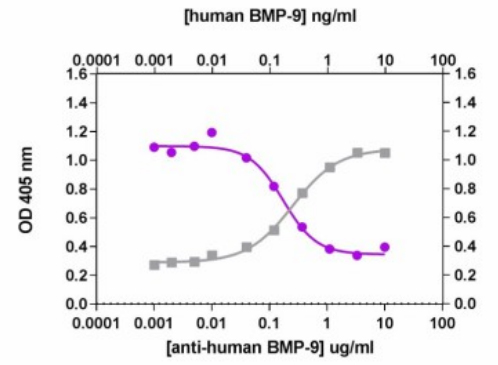
Functional antibody testing. Recombinant human BMP9 induces alkaline phosphatase in the ATDC5 mouse chondrogenic cell line in a dose dependent manner (black circles). Anti-human BMP9 monoclonal antibody (purple circles) neutralizes the production of alkaline phosphatase in ATDC5 cells induced by BMP9 (2 ng/mL). ND50 = 0.05 - 0.25 µg/mL. Data provided by BioLegend.
Advantages of recombinant antibodies
Recombinant antibodies share many of the advantages of hybridoma-derived monoclonals, including superior batch-to-batch reproducibility and reduced risk of non-specific binding compared with polyclonal antibodies. However, they also have several unique benefits. “Recombinant antibody production is far less tedious during the development phase compared with generating hybridoma-derived monoclonals,” explains Brian McWilliams, Ph.D., Product Manager at Bethyl Laboratories (a Fortis Life Sciences brand). “Further, recombinant antibodies do not suffer from genetic instability over time, which can lead to hybridoma cell lines being at risk or the antibodies gradually losing activity.”
One alarming statistic that is often highlighted is the fact that more than 30% of hybridomas are not actually monoclonal, leading to problems with binding specificity, affinity, and reproducibility. “Definition at the sequence level not only ensures lot-to-lot consistency, but also provides long-term protection against genetic drift, contamination, or other accidental loss,” says Fiebig.
An Ouyang, Product Manager at ACROBiosystems, notes that additional advantages of recombinant antibodies are that they can be readily manufactured at scale and have a central role in reducing animal use, which is championed by the U.S. Food and Drug Administration (FDA), European Medicines Agency (EMA), and other organizations to improve the safety and consistency of the final product. “Using modern technologies, recombinant antibodies can be manufactured in milligram, gram, or even kilogram amounts without compromising product quality and batch-to-batch consistency,” he says. “And because recombinant antibodies can be produced via animal-free methods, they alleviate ethical concerns around the use of animals for research.”
Complete control over the final product
A defining feature of recombinant antibodies is the tight control manufacturers have over their production. “At Bethyl, our recombinant antibodies are made from start to finish on-site,” explains McWilliams. “Everything from project initiation, antigen generation, and immunization, through to purification, screening, and validation takes place right here in our labs, and each antibody goes through a series of scientifically grounded steps to ensure binding specificity to the target of interest. This allows us to communicate any data that we generate to the scientists using our products, maximizing their chances of success in the lab.”
Greater experimental flexibility through engineering
Another important attribute of recombinant antibodies is their capacity for engineering into different species, isotypes, subtypes, and formats, which opens up new experimental possibilities for in vitro and in vivo use. “Being able to choose different species or isotypes can simplify co-labeling studies, reduce the number of necessary controls, or increase compatibility with a secondary antibody,” says Fiebig. “Additionally, novel formats such as fragments or murine knob-into-hole bispecifics are useful as surrogate molecules in drug development and immunotherapy research.” Absolute Biotech’s engineered antibody products include VivopureX™ antibodies, which are mouse-anti-mouse antibodies that offer reduced immunogenicity and tailored effector function for improved in vivo research in mouse models, and Fc Silent™ antibodies, which abrogate binding of Fc receptors to reduce non-specific background when immunostaining and remove effector function in vivo.
Recombinant antibody use continues to grow
The advantages of recombinant antibodies have seen their use grow year on year. “Every metric we track—both internally and market-derived—indicates that recombinant antibodies are growing in popularity and utilization,” comments McWilliams. Yet, there are still researchers who are hesitant to make the switch from traditional polyclonals and monoclonals.
“As more recombinant antibodies are cited in peer-reviewed literature, I’m certain that their use will become more widespread,” says Fiebig. “The scientific community should continue to encourage the adoption of recombinant technology for the wealth of benefits it offers, many of which are yet to be discovered.”