Protein pharmaceuticals represent a multibillion dollar market, but deciphering the most suitable biotherapeutic-producing cell lines is a substantial manufacturing bottleneck. “For innovators, it is all about time into the clinic. How fast can you get your molecule into a robust, stable, high-productivity cell clone?” explains Susan Sharfstein, professor of nanobioscience at SUNY Polytechnic Institute.
CHO cells have been the expression system of choice for producing these biological therapeutics for the past few decades. According to Sharfstein, “Some of this is historical; the FDA is quite comfortable with them so that makes regulatory approval easier.” But these cells are also fairly easy to work with, able to be grown in suspension, and relatively resistant to viral infection. She notes that CHO cells also share glycoforms more similar to human glycans than other rodent cell lines. But perhaps the most important aspect of CHO lines: they have the capacity to express a range of proteins, including enzymes and antibodies, at multi-gram per liter titer levels.
Unfortunately, this is only after the high-producing protein secretors are separated out from the low, a process that can be tedious, and involves the screening of thousands of clones over many weeks. Introducing multi-ORF (open reading frame) constructs into cells can lead to fragmented, disordered DNA becoming integrated into the genome instead of the requisite sequence, and this necessitates a critical prescreening step.
Ian Taylor, chief commercial officer for Solentim, says that there is an effort underway to streamline these processes and significantly shorten time to cell-line development. In 2019, Solentim partnered with ATUM to rapidly generate stable cell lines. ATUM’s Leap-In Transposase® expression technology touts integration efficiency “several orders of magnitude higher than conventional cells.” Taylor explains that by using transposases to deliver the GOI into cells, integration is targeted rather than random. The structural integrity of the construct, linkage of genes to the selection marker, and the ratio expression balance are all maintained. And insertion occurs in open areas of chromatin, which are more transcriptionally active. “The main benefit is they drive the clonal distribution in favor of high producers, meaning fewer clones per project need to be screened and no fluorescence reporting is required. A single project can now be achieved in 200 clones or less.”
Researchers can also help single clones bounce back and develop into colonies by adding growth supplements such as Solentim’s InstiGRO animal competent-free supplement to cloning plates.
Designer CHOs improving expression capabilities
Sharfstein’s lab has been researching productivity in CHO cell clones over the years, and she says that many things can influence output, including details of the culture conditions, as well as the characteristics of the proteins being expressed. “We did a really nice study several years ago with UCB Celltech examining the productivity of two monoclonal antibodies differing by a single amino acid with greater than 10-fold differences in productivity,” says Sharfstein.
One way to improved expression is through advances in different selection systems.
Metabolic selection has all but supplanted use of antibiotics, and can be broadly split into systems that inhibit glutamine synthetase (GS) or dihydrofolate reductase (DHFR), enzymes required for survival. GS is the more commonly used approach. In this case, transfected cells will not be viable unless they carry the GOI, which is linked to an exogenous GS gene. These systems are also informing CHO line engineering—a few companies now offer a GS-null CHO K1 line, eliminating the need for toxic chemical inhibition of GS.
This type of technology is fueled, in part, by the sequencing of the CHO genome earlier this decade and advances in gene-editing technology. “I think CRISPR and related technologies that will make all sorts of cell-line editing possible will be huge,” says Sharfstein. She is currently collaborating with Hocus Locus on a novel cell-line selection strategy based on expression of an siRNA in the 3’ untranslated region of the GOI. Cells are transfected with mRNA for a selection marker that can then be degraded by the siRNA. She says that this is significantly faster than antibiotic or deficiency complementation selection.
Editing goes beyond generating more efficient selection strategies; according to Sharfstein, she and others are working on cell-line development and bioprocess engineering for making heparin and heparan sulfates, which are carbohydrates, not proteins. “Production is a non-templated process, meaning that you have to do significant metabolic engineering to optimize the activities of the production pathways.”
CRISPR: a powerful tool that should be used with caution
Like Sharfstein, Anne-Marie Zuurmond, director of biology at Charles River Laboratories, thinks that it’s obvious that CRISPR is revolutionizing cell-line development. “The beauty of the system is that an RNA molecule is driving the specificity of the system and these molecules are easy to design and to produce. The CRISPR field is still in its infancy state, however is rapidly evolving,” notes Zuurmond. She says that targeting the mRNA to change the properties of a cell is a powerful tool since the host genome is unaffected.
On the CRISPR front, the focus these days is on the discovery of new nucleases. Zuurmond says “New Cas9-like proteins are still being discovered with different properties and requirements, thereby expanding the CRISPR toolbox for, what seems like, unlimited possibilities in genome editing and gene regulation.” Cas14 is one such example, isolated from archae bacteria, it is smaller than Cas9 and can also cut ssDNA. And another Cas9 variant was reported with minimal PAM requirements, meaning more parts of the genome can be targeted.
Still the new technology has drawbacks that must be acknowledged, including potential off-target effects. Zuurmond says that CRISPR also needs exogenous mediators to initiate the process of modifying the genome. She explains that Charles River uses CRISPR as an orthogonal approach to other strategies. “For the generation of protein overexpressing cell lines, both plasmid, lentivirus, and CRISPR approaches are being applied, covering the whole spectrum of transient and stable overexpression either from randomly or targeted integrated transgenes.” And many companies follow a similar approach, relying on older genome-editing techniques like rAAV (recombinant adeno associated virus), for example, and using CRISPR as proof of concept, or even blending the two methods.
Says Zummond, “Other genome-editing techniques and interference methodologies have their value and might, in certain situations, prevail over CRISPR. CRISPR should be considered as a very valuable technology that is adding to our cell-line engineering capabilities, but it is not the only option.”
Ensuring clonality
No matter the myriad reasons for cell-line development, whether for biotherapeutic protein production, gene therapy, or drug discovery, Taylor says researchers must ensure single-cell isolation and produce documentation of clonality. An issue that’s received lots of attention from the FDA in recent years, he warns that if cells are not clonal, one line might have a competitive advantage and outgrow the other. “This could lead to a reduction in product output or even the wrong product being produced—a very expensive mistake.”
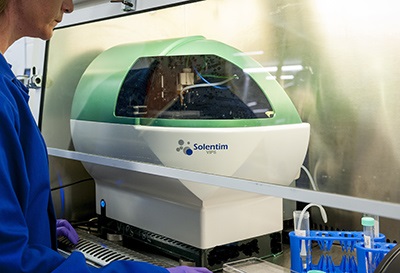
Solentim offers instruments like the VIPS (Verified In-situ Plate Seeding) to help ensure documenting of clonality is routine and easy. The VIPS can seed single cells into dry wells in 96 well plates and do imaging to meet clonality requirements. The Cell Metric, also by Solentim, is an imager used to track the growth of the clone into a colony, which Taylor says is required by the FDA.
Between more targeted gene-integration approaches, updated clonal selection processes, the ever expanding field of CRISPR, and accessible automation, robust cell-line development workflows are becoming more efficient than ever before, impacting nearly every field of biomedical research and accelerating the discovery and generation of protein- (and even carbohydrate-) based therapeutics.
Image: VIPS single-cell seeding system, which must be located in a Class II Biosafety Cabinet. Image courtesy of Solentim