The cell-therapy market keeps growing. According to one forecast, the global market will soar toward $10 billion by 2026—driven by a 7.2% compound annual growth rate for 2018–2026. To provide the needed cells for so much growth, companies must scale up processes, all while reducing the odds of a batch failing or getting contaminated.
Some scientists working with cell-based therapies see the need for new techniques. As an example, Petra Hanga—a lecturer in biomedical engineering at Aston University—and her colleagues wrote: “As more and more cell and gene therapies are being developed and with the increasing number of regulatory approvals being obtained, there is an emerging and pressing need for industrial translation.” Plus, commercial processes must meet good manufacturing practice (GMP) regulations.
When asked to discuss the biggest challenges in cell-expansion processes, Darren Whitley—single-use smart consumables specialist for North America at Sartorius Corporation—said: “GMP cell expansions face greater risk of contamination due to the number of open processes for media transfer, inoculation, and sampling at each cell passage.” He added, “Contaminations in seed expansion threaten on-time inoculation of the seed bioreactor, which can in turn impact deadlines for regulatory submissions, manufacturing forecasts, and drug availability for patients.”
So, companies need ways to keep contamination out of cultures. Plus, the cultures need to grow successfully. As such, cell-therapy manufacturers continually seek better ways to create the cultures that they need to grow a product.
Cutting contamination
Anyone who ever cultured cells knows about the risk of contamination. Scientists use a variety of methods to reduce the odds of contaminating a culture. To keep those odds as low as possible, scientists need to know what steps create the most risk when making a cell-based therapy.
“The main risk of contamination occurs mostly during the steps when shake flasks are repeatedly uncapped,” Whitley said. “Uncapping is usually required to conduct liquid transfers into and out of media bottles and shake flasks.”
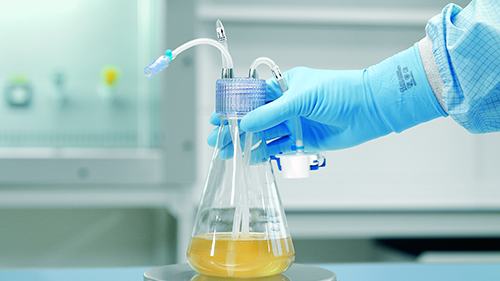
The environment contributes to that contamination risk, but even the standard precautions are not always enough to prevent the problem. “Despite these operations being conducted under the laminar flow hood or biosafety cabinet, there are still significant contaminations,” Whitley explained. “Traditional risk-mitigation strategies usually include creating backup seed trains by splitting the culture at various points and operating under the hood with good aseptic technique.”
Image: Scientists use various tools to reduce the odds of contamination or failure when expanding cells. Image courtesy of Sartorius Corporation.
Although technique makes a big difference in the ability to limit contamination, new technology also helps. “Sartorius innovated a specialized cap for the shake flask that does not need to be removed, because it accomplishes both the gas exchange function for cell growth and has the integral tubing required for aseptic liquid transfers to and from the flask,” Whitley said. “In most cases, this means that the only open operation is the inoculation of the first shake flask from the thawed working cell bank.” The odds of contamination increase every time that a culture is exposed to its environment. So, less exposure means less contamination.
In addition, improved technology, such as the Sartorius cap, can make aseptic techniques easier. “Since you no longer remove the cap, you no longer need to go under the hood,” Whitley noted. “A closed operation greatly minimizes the risk of contamination.”
Adding automation
Beyond just bad, contamination of a culture can be catastrophic. “During the multiple expansion steps from a working cell bank to inoculation of the seed bioreactor, the biggest threat to batch failure is contamination,” Whitley explained. To reduce the hands-on steps, automation can be added.
As Ilyas Singeç—director of the stem cell translation laboratory at the U.S. National Institutes of Health—and his colleagues wrote: “…to fully harness the therapeutic potential of [induced pluripotent stem cells], it is critical to establish well-controlled, safe, and efficient strategies for cell line generation, cell expansion, directed differentiation into multiple phenotypes, and large-scale cell production.” To work on such cells, these scientists explored some automated methods.
In discussing the cost, efficiency, and regulation of manufacturing for cell and gene therapy, Hanga’s team wrote: “Automation has the potential to address these issues and pave the way toward commercialisation and mass production as it has been the case for ‘classical’ production industries.”
More than being faster, more efficient, and more repeatable, automating steps in cell culturing cuts back on the hands-on procedures that increase the potential of contamination. The variety and number of steps involved in culturing cells create a fundamental challenge in battling contamination. As Whitley pointed out: “Contamination may be caused by a variety of sources, so process developers are typically aiming to build safeguards into the process.” Automation offers a valuable safeguard—partly by reducing human error.
Sartorius adds automation to various cell-culturing processes. As an example, Whitley said, “Sartorius has developed a GMP software application using a 21 CFR part 11–compliant Cubis II balance to control a Watson Marlow pump, executing the filling and transfer procedures in cell expansion using a touchscreen GUI on the balance.” He added, “The balance performs the density calculations and achieves the correct ratios of media and inoculate for the operator so that they can focus on safety, sterility, and compliance.” Sartorius also offers other options in automation that can be used when making cell-based therapies. “From the thaw to inoculating the seed bioreactor,” Whitley said, “Sartorius’ MYCAP CCX provides a semi-automated, closed system that greatly improves upon traditional cell-expansion operations.”
It will take many improvements—better tools and techniques, advances in automation, and more—to drive the manufacturing needed for the evolving and expanding cell-therapy market. In addition to providing more cells, the industry will need to increase the speed of delivery, especially as physicians prescribe these treatments to more patients. The continued increase in cell-based therapies appears inevitable. So, the production industry must improve wherever possible.