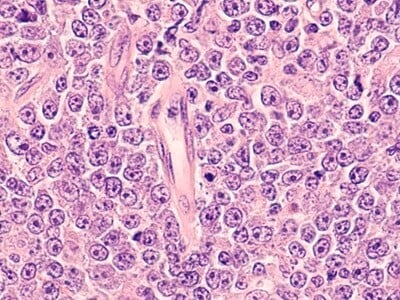
 Lymphomas are hematologic malignancies displaying biological and clinical diversity. This heterogeneity manifests across disease presentation, genetic alterations, tumor microenvironment (TME) composition, and therapeutic response, making accurate diagnosis and risk stratification particularly challenging. Lymphoma evaluation relies on histopathology, single-plex immunohistochemistry, and flow cytometric immunophenotyping, complemented by genetic and molecular profiling. These approaches exhaust specimens, yet fail to fully resolve the spatial and functional complexity of the TME, central to lymphoma pathogenesis, immune evasion, and treatment resistance.
In this poster from Bio-Techne, discover how hyperplex sequential immunofluorescence (seqIF) can, using a single section, simultaneously characterize cellular composition, TME spatial architecture, and heterogeneity across lymphoma subtypes.