At-a-Glance:| Company | AcroCyte Therapeutics, Inc. |
|---|
| Specialties | Scaffold-free 3D cell culture and organoid technology for expanding rare, patient-derived cells |
|---|
| Mission | To advance functional precision medicine by enabling the rapid and reproducible expansion of rare patient-derived cells into biologically relevant three-dimensional models, reducing reliance on traditional cell lines and animal models.. |
|---|
| Noteworthy | First company in Asia to receive funding from the U.S. Advanced Research Projects Agency for Health (ARPA-H), awarded in 2026 for RACE (Rapid and Reliable Autologous Cell Screening and Expansion for Organoid Therapy and Bioartificial Kidney Construction), an international kidney regeneration program. |
|---|
| Location | Taipei, Taiwan and San Carlos, CA |
|---|
| Co-Founder and CEO | Dr. Ying-Chih Chang |
|---|
AcroCyte Therapeutics, Inc. was founded in 2020 to commercialize technologies arising from research led by Co-Founder and CEO Dr. Ying-Chih Chang, a research fellow at the Genomics Research Center, Academia Sinica. Drawing on her interdisciplinary background in chemical engineering, materials science, biomaterials, and cell biology, Dr. Chang investigated how bio-inspired surface properties influence cellular behavior and guide cells from conventional two-dimensional monolayer growth into three-dimensional spheroid structures.
Dr. Chang’s earlier research also focused on developing technologies to capture and recover viable circulating tumor cells (CTCs), rare but highly informative cancer cells found in the bloodstream. This work highlighted a key limitation in precision medicine research: rare patient-derived cells are often available in quantities too small for drug testing, functional analysis, disease modeling, or long-term study. Conventional 3D cell culture methods present additional challenges. Scaffold-based systems may be limited by poor optical clarity, difficult cell retrieval, and batch-to-batch variability, while ultralow-attachment methods may result in uncontrolled aggregate fusion and inefficient spheroid formation. These limitations can make 3D cell culture difficult to reproduce and scale.
To address both the scarcity of patient-derived cells and the limitations of existing 3D culture methods, Dr. Chang’s laboratory developed R³CE® (Rapid, Reproducible, Rare Cell 3D Expansion). The scaffold-free platform is designed to rapidly and reproducibly expand rare cells, including CTCs, biopsy-derived cells, stem cells, and other patient-derived materials, into three-dimensional cellular models. Its proprietary optically transparent nano-coating supports cell expansion and self-assembly into 3D structures without the use of hydrogels. The R³CE® platform is also designed to integrate with established cell culture, imaging, and high-throughput drug-screening workflows, simplifying the transition from conventional 2D culture to human-relevant 3D models.
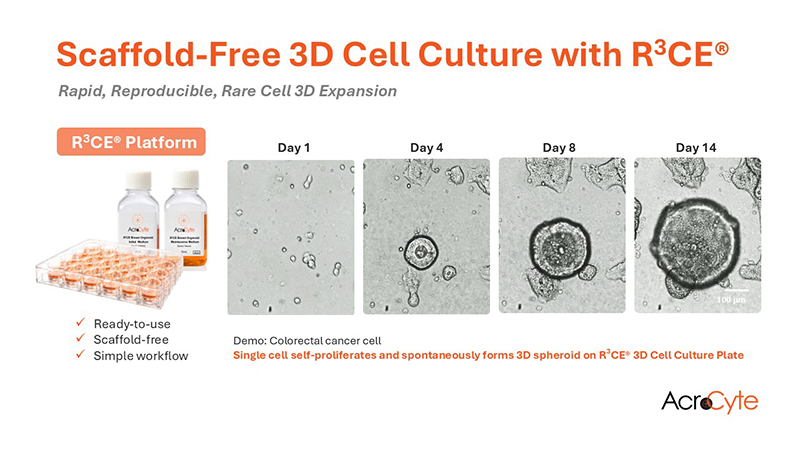
The R³CE® platform combines scaffold-free 3D cell culture plates and with R³CE® culture media to support 3D spheroid formation. Representative images show colorectal cancer cell growth and spheroid formation from Day 1 to Day 14. The R³CE® platform combines scaffold-free 3D cell culture plates and with R³CE® culture media to support 3D spheroid formation. Representative images show colorectal cancer cell growth and spheroid formation from Day 1 to Day 14.
AcroCyte believes that functional testing using living patient-derived cells can complement genomic and molecular profiling by providing biological insights that may not be fully captured through conventional cell lines, animal models, or genetic sequencing alone. The company’s long-term vision is to make patient-derived functional testing more practical and accessible for human-relevant research, therapeutic development, and personalized medicine.
Today, AcroCyte develops scaffold-free 3D cell culture technologies built on the R³CE® platform. The R³CE® 3D Cell Culture Plate supports the expansion of rare and patient-derived cells, including CTCs, biopsy-derived cells, stem cells, and organoid-forming cells, on a proprietary, optically transparent nano-coated surface. Unlike many hydrogel-based systems, it does not require animal-derived matrices such as Matrigel, and is compatible with established cell culture and imaging workflows, allowing researchers to integrate 3D culture into existing laboratory practices with minimal workflow changes.
Used in combination with the plate, R³CE® Organoid Medium supports the establishment, expansion, and maintenance of patient-derived organoids from limited clinical specimens, including surgical tissues and needle biopsies. The product line includes a general-purpose basal medium and specialized formulations developed for gastrointestinal, breast, liver, and ovarian models, designed to support reproducible organoid culture while helping maintain cellular heterogeneity, tissue architecture, and functional characteristics. Depending on the specimen type and culture conditions, organoid formation may be observed in approximately two weeks.
R³CE® CTC Medium supports the survival and expansion of CTCs derived from patient blood samples, providing an accessible source of patient-derived cancer cells that does not require surgical tissue collection.
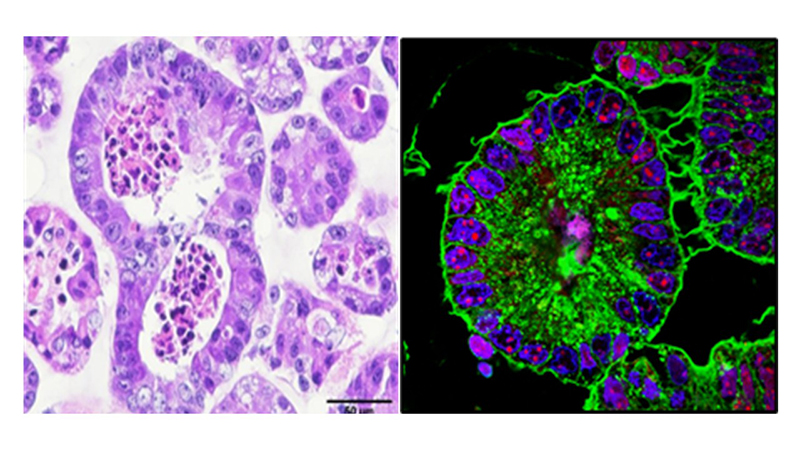
Patient-derived colorectal cancer tumoroids were generated using the R³CE® platform. Hematoxylin and eosin (H&E) staining (left) shows gland-like architecture and tissue organization, while immunofluorescence (IF) staining (right) visualizes cellular organization within the 3D tumoroid.
Together, these tools support applications including drug discovery, disease modeling, regenerative medicine research, drug-response studies, functional assays, and multi-omic analysis, complementing genomic and molecular profiling with functional insights from living patient-derived cells. The growing adoption of New Approach Methodologies (NAMs) further underscores the need for reproducible, scalable, and human-relevant in vitro models of this kind.
The R³CE® platform has drawn international recognition. In 2024, AcroCyte Therapeutics was named a finalist in the BIO International Convention Start-Up Stadium competition in San Diego, advancing to the final round alongside biotechnology startups from around the world. In 2025, the company received second place at the 14th MEDICA START-UP COMPETITION in Düsseldorf, Germany, one of the world’s largest medical technology innovation events. The award recognized the R³CE® technology’s ability to enable rapid expansion of rare cells and the generation of personalized three-dimensional cellular models from limited patient-derived samples.
In 2026, AcroCyte Therapeutics became the first company in Asia to receive funding from the U.S. Advanced Research Projects Agency for Health (ARPA-H) for RACE (Rapid and Reliable Autologous Cell Screening and Expansion for Organoid Therapy and Bioartificial Kidney Construction), an international kidney regeneration program. The program brings together AcroCyte Therapeutics, which provides its autologous kidney cell expansion platform, National Taiwan University Hospital, and other partners to advance cross-border translational research. The project applies AcroCyte’s proprietary R³CE® platform to expand patient-derived kidney cells for regenerative medicine research and the future development of autologous cell therapies, marking a step toward expanding the application of R³CE® platform into regenerative medicine.