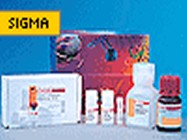
Extracting protein digests from SDS gels can be considered an art form, but with the right protocol in hand, the art can be handled more like a science. There are a myriad of methods out there that have highly variable protocols requiring optimization of components. In addition, buffers must be made carefully and consistently for reproducibility, maximum peptide digestion and extraction efficiency. In response to demand, Sigma has produced an in-gel protein digest kit that provides all components for digestion and extraction of peptides for protein identification from an excised gel band!
The kit provides a bottle of ammonium bicarbonate destaining solvent (comes as pre-weighed powder) to follow visualization with Coomassie Blue (good for 2 weeks in refrigerator following preparation). Five vials of 20ug Proteomics Grade Trypsin (Sigma T6567) are also provided and the protocol suggests initial reconstitution in 100L of the kit’s Trypsin Solubilization Reagent (1mL of 1mM HCl used for stabilizing the enzyme). This solution is then diluted in 900uL of the provided Trypsin Reaction Buffer (comes pre-weighed), which maintains an optimal pH for the reaction. Water and acetonitrile need to be added, however the acetonitrile is also included in the kit (Biotech grade, 50 mL). There is 1mL (20ug/mL) of the prepared solution although it can be concentrated to 200ug/mL, aliquoted and stored as a frozen concentrate for up to four weeks. The trypsin is stable for at least 3 freeze-thaw cycles. As purchased, the kit’s non-enzyme contents (powders and solvents) are stable for 1 year, if refrigerated. Once made, most of the solutions have a two-to-four week shelf life, although some reagents have a longer shelf life than others.
The protocol can be performed in approximately 8 hours, split between 2 days. The procedure involves destaining, desolvating the gel piece completely (a Speed-Vac is recommended), re-solvating in the trypsin solution and incubating overnight (suggested). The incubation can be shortened to four hours, but this may take a toll on digestion efficiency. During incubation, the peptides are extracted in a single low-volume aliquot; the minimum recommended extraction volume is 50uL. The extracts are then ready for further analysis by mass spectrometry, however, for low concentrations the peptides should be further concentrated to obtain the best sensitivity. If a subsequent extraction is needed, an Extraction Buffer is included but typically, only gained about 5% more material than reported. When analyzed by MALDI-TOF-MS, the spectra look as good as other in-gel trypsin protocols used by this laboratory. We did notice a slight increase in peptide extraction (i.e. better sequence coverage), however, a direct comparison between different protocols has not yet been strictly executed for the exact same samples. I would recommend giving the ProteoPrep In-Gel Digest Kit a try and compare it to your current in-house protocol to see if it benefits your lab’s protein identifications.
Ronald A. Miller
Research Biochemist
Merck Research Laboratories
Department of Alzheimer's Disease Research