New research contradicts the standard thinking on how sperm 'swim'. According to a study published today in Science Advances, the belief that human sperm have a "tail, which, when swimming, lashes with a snakelike movement, like eels in water," is an optical illusion.
A team from the University of Bristol and the Universidad Nacional Autonoma de Mexico have reconstructed the true movement of the sperm tail. Using a high-speed camera capable of recording over 55,000 frames in one second, and a microscope stage with a piezoelectric device to move the sample up and down at an incredibly high rate, they were able to scan the sperm swimming freely in 3D.
What they found is that the sperm tail is in fact wonky and only wiggles on one side. While this should mean the sperm's one-sided stroke would have it swimming in circles, sperm have found a clever way to adapt and swim forwards. "Human sperm figured out if they roll as they swim, much like playful otters corkscrewing through water, their one-sided stoke would average itself out, and they would swim forwards," said Dr Hermes Gadelha, a co-author on the paper.
Search Antibodies Search Now Use our Antibody Search Tool to find the right antibody for your research. Filter
by Type, Application, Reactivity, Host, Clonality, Conjugate/Tag, and Isotype.
"The sperms' rapid and highly synchronised spinning causes an illusion when seen from above with 2D microscopes—the tail appears to have a side-to-side symmetric movement, "like eels in water,” Gadelha explained. "However, our discovery shows sperm have developed a swimming technique to compensate for their lop-sidedness and in doing so have ingeniously solved a mathematical puzzle at a microscopic scale: by creating symmetry out of asymmetry," Gadelha added.
"With over half of infertility caused by male factors, understanding the human sperm tail is fundamental to developing future diagnostic tools to identify unhealthy sperm," added Gadelha.
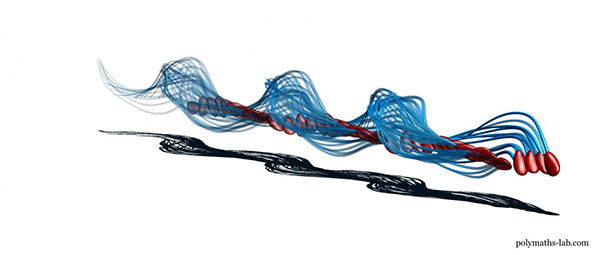
Image: Sperm tail moves like a precessing spinning top that cancels out the one-sided swimming stroke in an ingenious corkscrew motion: Symmetry is achieved through asymmetry, enabling human sperm to swim forwards.