Using an in silico computational framework called pathogen host interactome prediction using structure similarity (P-HIPSTer), biologists at Columbia University have mapped protein-protein interactions between all known human-infecting viruses and the cells they infect. The atlas was published yesterday in Cell.
To date, considerable effort has been invested in identifying these interactions. However, traditional methods are limited in terms of scalability, efficiency, and even access. To address this challenge, the team developed P-HIPSTER, which infers interactions between pathogen and human proteins.
"There are over 1,000 unique viruses that are known to infect people," says senior author Sagi Shapira, Ph.D. "Yet, despite their unquestionable public health importance, we know virtually nothing about the vast majority of them. We just know they infect human cells. The idea behind this effort was to systematically catalogue the interactions that viruses have with the cells they infect. And, by doing so, also reveal some really interesting biology and provide the scientific community with a resource that they can use to make interesting observations of their own."
Search Antibodies Search Now Use our Antibody Search Tool to find the right antibody for your research. Filter
by Type, Application, Reactivity, Host, Clonality, Conjugate/Tag, and Isotype.
Dr. Shapira and his collaborators applied P-HIPSTer to all 1,001 human-infecting viruses and the approximately 13,000 proteins they encode. The algorithm predicted roughly 280,000 likely pairs of interacting proteins that represent a comprehensive catalogue of human virus protein-protein interactions with an accuracy rate of almost 80 percent.
"This is the first step towards building a comprehensive cartography of physical interactions between different organisms," Dr. Shapira says.
 In addition to defining pan-viral protein interactions, P-HIPSTer has yielded new biological insights into Zika virus, HPV, and the impact of viruses in shaping human genetics. The researchers found that Zika virus interacts with estrogen receptor, which has the has potential to inhibit Zika virus replication. "And, in fact, estrogen receptor inhibits viral replication even more than interferon, a protein that is the body's first line of defense to viral infection and our gold standard for anti-viral defense," explains Dr. Shapira.
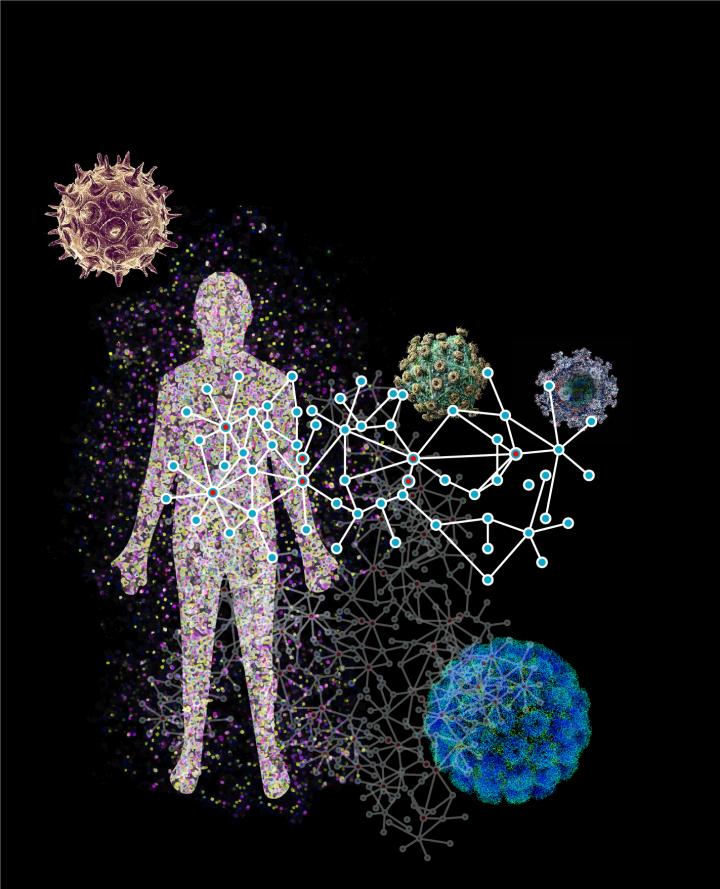
Image: P-HIPSTer infers interactions between pathogens and human proteins. The framework is being used to understand how viruses infect human cells. Image courtesy of Sagi Shapira, Ph.D., Columbia University Vagelos College of Physicians and Surgeons.