Cells are social. A critical aspect of group behavior is self-recognition, as cells assist kin and antagonize non-kin in foraging for food and forming biofilms. In a study published last week in Cell Reports, scientists discovered that cells can distinguish themselves from closely related competitors through the use of a virus, and the harboring of phage in bacterial genomes benefits host cells when facing competitors in the environment.
Search Antibodies Search Now Use our Antibody Search Tool to find the right antibody for your research. Filter
by Type, Application, Reactivity, Host, Clonality, Conjugate/Tag, and Isotype.
The researchers found that a boundary (demarcation line) was formed due to phage lysis between different swimming E. coli strains but not between identical clones; hence, motile bacterial cells discriminated between self and non-self. The basis for this self-recognition is a T1-type lytic phage of the family Siphoviridae (named SW1) that controls the formation of the demarcation line by utilizing one of the host’s cryptic prophage proteins, YfdM of CPS-53, to propagate.
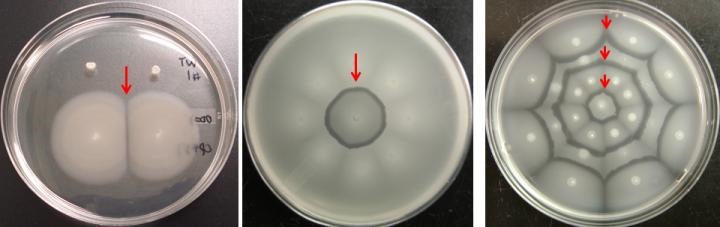
SW1 provides a conditional benefit to E. coli compared to the identical strain that lacks the phage. Additionally, a demarcation line also forms when E. coli strains harbor either the lysogenic phage φ80 or lambda and encounter siblings that lack the lysogen. Thus, the relationship between a virus and its cellular host should be re-evaluated, since a viral infection is sometimes beneficial.
Image: Demarcation lines (shown by red arrows) developed between cells of self and of non-self. Image courtesy of WANG Xiaoxue.