UC Davis researchers have reported a breakthrough in understanding which cells afford optimal protection against Salmonella infection—a critical step in developing a more effective and safe vaccine against a bacterium that annually kills an estimated one million people worldwide. Their research was published in PNAS this week.
"What everyone has been focused on in immunology, not just in addressing Salmonella, but all infectious diseases for the past 50 years or so, has been antibody and T cell responses," Stephen McSorley, interim director of the Center for Comparative Medicine, said. "What hasn't been realized until very recently is there are actually two different categories of T cells—those that circulate through tissues in the body and those that never move and are known as tissue resident or non-circulating memory cells."
Since non-circulating memory T cells were discovered, McSorley said there's been a rush in different disease models to understand whether they are important or not—in cancer and infectious diseases. It seems in some models they are very important; in others, they are less so. "It's a new cell population we haven't looked at before and they're very effective so we need to learn more about them," McSorley said. "They may be part of the answer to developing vaccines against a variety of pathogens."
The researchers transferred circulating and non-circulating memory T cells from mice previously vaccinated into naïve mice. Thanks to fluorescent markers, they were then able to track which of the T cells offered protection against Salmonella infection. They showed that vaccine-mediated protection requires a non-circulating population of liver memory cells that does not circulate through the rest of the body. The unexpected requirement for these liver memory T cells means that generating these cells will form the basis of future vaccines for typhoid and NTS.
"The goal of our lab is to understand the mechanisms of protective immunity in mice to learn tricks of the immune system and then develop a vaccine that could replicate that to use for kids and people who live in [Asia and Africa]," he said. "We found that you absolutely need these non-circulating T cells to protect against Salmonella. That's an important milestone because if you're going to make a vaccine, you have to know what you're trying to induce with that vaccine. Now that we know these forms of T cells exist and protect against Salmonella, the next goal is to try to develop synthetic ways to induce them to make a vaccine."
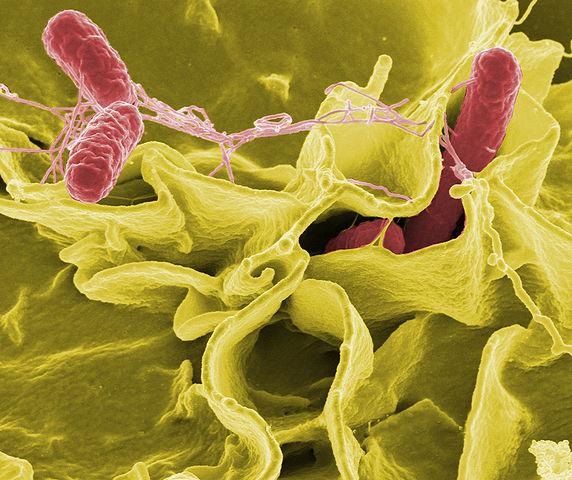
Image: UC Davis researchers have made a breakthrough in understanding which cells afford optimal protection against Salmonella infection—a critical step in developing a more effective and safe vaccine against a bacterium that annually kills an estimated one million people worldwide. This image shows Salmonella (in red) invading human cells. Image courtesy of Rocky Mountain Laboratories, NIAID, NIH.