Telomerase has been a great enzyme of interest since its Nobel Prize-winning discovery for its central role in cancer and aging. While various structures have been released, how certain pieces of RNA components fit into the entire holoenzyme complex have remained a mystery, partly due to conflicting results from many different labs. In a recent publication in Nature, a team has revealed the full structure of the active human telomerase at subnanometer resolution. The work, which centers on cryoelectron microscopy (Cryo-EM) comes from a team at the University of California Berkeley.
"The best previous images of human telomerase had a resolution of only 30 Ångstroms; we were able to get about 7 to 8 Ångstroms resolution using cryoelectron microscopy. When I got to the point where I could see all the subunits - we had 11 protein subunits in total - it was a moment of, 'Wow, wow, this is how they all fit together,” said study first author Thi Hoang Duong "Kelly" Nguyen.
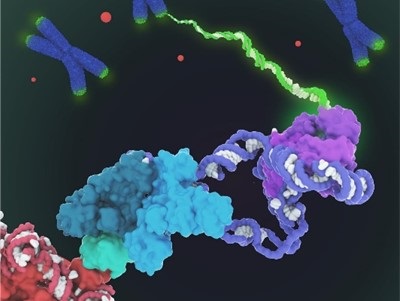 Nguyen was able to isolate the active enzyme and purify it much better than previous efforts by others. Then from their Cryo-EM work, the team determined that the holoenzyme featured two flexibly RNA-tethered lobes. One of these was the catalytic core that comprised the telomerase reverse transcriptase (TERT) and conserved motifs of telomerase RNA (hTR). In this core, RNA encircles TERT in a well-ordered tertiary structure with surprisingly limited protein-RNA interactions.
Through this newly defined structure, the team also gained new insights on the genetic disease dyskeratosis congenita, the first known human disease caused by a telomerase mutation. In the disorder, two RNA-bound dyskerin proteins must interact with both network proteins and each other. The mutation prevents these linkages and cripples the structure of the RNA backbone.
The team is now actively working to improve their resolution to 3 or 4 Ångstroms, which is about the size of two carbon atoms. At this resolution, it would be possible to screen for much more meaningful interactions between drugs and target proteins.
"I became curious about how telomerase works in 1991, when I was just finishing as a grad student,” said principal researcher Kathleen Collins. She began working on the structure 26 years ago when the first human telomerase was discovered. "It has been a long time coming. It took a lot of persistence."
Image: The space-filling model of human telomerase holoenzyme structure determined by Cryo-EM. Image courtesy of Janet Iwasa.