ZC3H11A is a human gene that, aside from its designation as a “zinc-finger domain-containing protein,” has no defined or particularly exciting function. Through CRISPR editing methods, a team has now discovered a role for ZC3H11A in viral infections—opening up its potential to become a broad spectrum anti-viral target. The findings released today in PNAS come from a team led by Uppsala University researchers.
"We have been interested in this gene for several years and finally decided to use gene editing (CRISPR-Cas9) to inactivate the gene in a human cell line. However, inactivation of ZC3H11A had little effect showing that this gene is not essential for the growth of these human cells," explained lead co-author Shady Younis on what first seemed like disappointing findings.
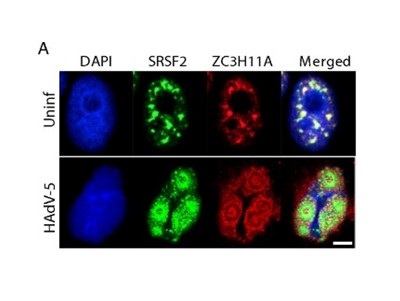 The team then decided to infect ZC3H11A-knockout HeLa cells with viruses. To their surprise, the team found a drastic reduction in adenovirus growth when compared to normal cells expressing ZC3H11A. The serendipitous discovery subsequently extended onto other viral species.
"We have now demonstrated that at least four different viruses, adenovirus, influenza virus, HIV and herpes simplex virus, that all replicate in the host cell nucleus is dependent on the ZC3H11A protein for their efficient growth," said study co-author Wael Kamel. "These viruses need ZC3H11A for the transport of virus RNA from the nucleus to the cytoplasm where the virus proteins will be produced before the viruses can exit the cell and infect other cells."
High-throughput sequencing of extracted RNA that was bound to ZC3H11A showed that the ZC3H11A protein binds to short viral RNA segments. In their paper, the team proposed that ZC3H11A is a stress-induced RNA binding protein involved in an unknown cellular stress response mechanism.
"The observation that the amount of ZC3H11A protein increases during a virus infection was a very surprising finding since viruses typically shuts down host cell protein expression to favour virus production," noted senior co-author Göran Akusjärvi. "Our data suggest that nuclear-replicating viruses have hijacked a cellular mechanism for RNA transport activated during stress for their own advantage."
"There is a strong need to develop new anti-viral drugs as is well illustrated by the quite severe influenza we have had this winter," said senior co-author Leif Andersson. "A major goal for the team is now to test if they can block how viruses take advantage of the function of the ZC3H11A protein and if this will impair virus growth in living animals, not only in cells as they have proven in the current study."
Image: Immunofluorescence staining of WT cells using anti-ZC3H11A and anti-SRSF2 antibodies before and after infection with HAdV-5. Image courtesy of Leif Andersson and PNAS.