Breast cancer notoriety arises from its capacity to metastasize and develop resistance to current therapies. To overcome these feats, a University of Liverpool-led team looks to a cell signaling pathway that is driven by macrophages, which are abundant in the breast cancer tumor microenvironment.
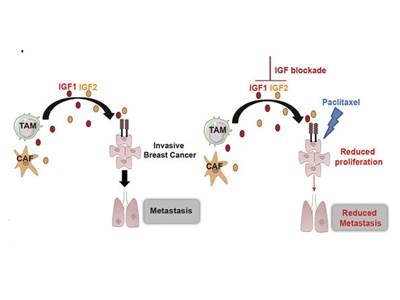 In their paper published today in Nature Oncogene, the team finds “that breast cancer-associated macrophages express high levels of insulin-like growth factors 1 and 2 (IGFs) and are the main source of IGFs within both primary and metastatic tumors.”
When examining breast cancer patients, 75% show activation of the insulin-IGF receptor signaling pathway, which also correlate with increased macrophage infiltration and advanced tumor stage. This rate increases to 87% among breast cancer patients with an invasive tumor stage.
In mice implanted with breast cancer cells, the team then conducted a series of experiments that tested the effects of the breast cancer drug paclitaxel, as well as xentuzumab, an IGF-blocking antibody. Compared to treatment with paclitaxel alone, the findings showed that a combination of the two agents resulted in a significant reduction in both tumor cell proliferation and lung metastasis.
Lucy Ireland, study first author, comments, “I am thrilled by our findings, as the combination therapy is more effective than the current treatment in pre-clinical models of breast cancer."
The paper concludes that, in addition to the combination treatment, elements involved in insulin-IGF receptor activation and IGF+ stroma cells should be further investigated as new candidates for biomarkers.
"Our findings provide the rationale for further developing the combination of paclitaxel with IGF blockers for the treatment of invasive breast cancer,” said senior study author Ainhoa Mielgo. "A better understanding of the mechanisms underlying the metastatic spreading of breast cancer is critical to improve treatment and patient outcome.”
Image: Schematics describing the role of IGF from tumor-associated macrophages in regulating the response of metastatic breast cancer to paclitaxel. Image courtesy of Ainhoa Mielgo and Springer Nature.