Besides providing off-the-shelf products, antibody manufacturers may offer additional services such as custom antibody development or engineering. This article looks at when to consider these options, before delving into some of the different types of antibody engineering being used to advance scientific research.
Search Antibodies Search Now Use our Antibody Search Tool to find the right antibody for your research. Filter
by Type, Application, Reactivity, Host, Clonality, Conjugate/Tag, and Isotype.
Reasons to consider custom antibody development
Although modern researchers have access to a vast array of antibody reagents, there can still be times when the desired product is not available commercially. In this situation, partnering with a custom antibody service provider can help keep research projects on track. “Most commonly, requests for custom antibodies start when the antibodies that are currently on the market don’t perform in whatever application the researcher requires,” says Brian McWilliams, Ph.D., Product Manager—Life Sciences at Bethyl Laboratories (a Fortis Life Sciences brand). “Customers may also wish to own the intellectual property associated with a given antibody, or require that specific characteristics be introduced into their antibody clone.” Ways of addressing these needs include developing a new antibody from scratch and performing antibody engineering.
Types of recombinant antibody engineering
Antibody engineering first became possible in the 1980s, following the recombinant DNA revolution, when efforts were largely focused at creating human therapeutics. More recently, engineering methods have been applied to research antibodies, including the approaches described below:
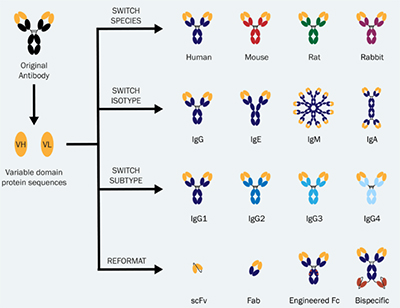
Types of antibody engineering. Image provided by Absolute Antibody.
• Species switching
Reasons to consider: to increase diversity in a panel of antibodies for multiplexing; to reduce complexity in a panel of antibodies to streamline processing steps (e.g., conjugations); to lessen immunogenicity for in vivo applications.
“Species switching results in a chimeric antibody, consisting of the variable domains from your original antibody and the constant domains from a different species,” explains Michael Fiebig, Ph.D., Chief Scientific Officer, Absolute Antibody (an Absolute Biotech company). “Because the appropriate sequence can be determined from the species’ genome, even if only partial assemblies are available, antibodies can be switched to almost any species.” A main reason to perform species switching is to simplify panel design for multiplexed flow cytometry or immunofluorescence studies. In addition, species switching of antibodies used in vivo is important to avoid immunogenicity. “Using immunogenic antibodies in vivo leads to anti-drug antibodies and anaphylactic responses, which negatively impact experimental read outs—you just shouldn’t do it,” says Fiebig.
• Isotype switching
Reasons to consider: to reduce non-specific staining of Fc receptor-expressing cells; to increase antibody avidity; to overcome issues with aggregation; to alter the in vivo effector function or stability.
Isotype switching involves altering an antibody’s isotype or subtype. For example, an IgG1 antibody might be switched to IgM, IgY, or another IgG subtype. “When using antibodies for applications such as flow cytometry or immunofluorescence, you can reduce non-specific staining of Fc receptor-expressing cells by opting for a naturally occurring isotype with low Fc receptor binding, or an engineered, Fc Silent™ antibody,” says Fiebig. “And, when working in vivo, the Fc domain of an antibody can be engineered to impart different effector functions to the same antibody clone. For example, you might want to use an Fc Silent antibody for blocking applications, antibodies with medium- or high-FcgR binding for agonism of receptors requiring cross-linking such as TNFR-superfamily members, or high-FcgR binding antibodies for depleting activity.”
• Fragmentation
Reasons to consider: to abolish Fc-mediated interference; to improve the linear range of assays; to facilitate tissue penetration; to address challenges related to steric hindrance.
Traditional proteolytic methods for producing antibody fragments such as Fab and F(ab)’2 can be inconsistent and yield unwanted by-products. For these reasons, Fab, F(ab)’2, and other types of antibody fragments, such as single-chain variable fragments (scFv) and single-domain antibodies (sdAb), are being generated recombinantly to meet various research needs. “The smaller size of antibody fragments makes them useful for targeting difficult-to-reach epitopes or for overcoming steric hindrance in applications using multiple antibodies,” explains McWilliams. Additionally, the lack of an Fc region abolishes Fc-mediated interference, while the 1:1 stoichiometries exhibited by Fabs, scFvs, and sdAbs for their specific analytes can improve the linear range of assays. “At Bethyl, we’ve seen growing demand for our single-domain antibodies,” comments Aliyah Weinstein, Ph.D., Sr. Marketing Programs Manager, Antibody. “The unique properties of these antibodies, which include improved solubility, thermostability, and pH stability compared with conventional antibodies, make them well-suited to a broad range of research, diagnostic, and therapeutic applications.”
• Tagging
Reasons to consider: to simplify purification, detection, immobilization, or functionalization.
“Depending on the type of tag that is used, tagging can be helpful for purifying an antibody, creating a known epitope for secondary antibody binding, or providing a direct means of visualization,” says McWilliams. Tags can also be used to provide site-specific orientation or to functionalize an antibody. “For functionalization, a classic example is the Avi tag, which can be site-specifically biotinylated by the biotin ligase BirA,” reports Fiebig. “There are, however, more versatile systems based on tags like the Sortag, which can be used to attach a fusion through a sortase-enzyme mediated reaction, or intein-based fusion pairs mediating transpeptidase reactions to site-specifically fuse entire proteins.”
Looking to the future
Beyond the types of antibody engineering just discussed, it is also worth mentioning the development of bi-specific and multi-specific antibodies. Examples include bi-specific killer engager (BiKE) antibodies, which simultaneously bind an antigen on tumor cells and a surface molecule on natural killer (NK) cells to induce tumor cell lysis, and tri-specific killer engager (TriKE) antibodies, which incorporate a third binding modality to drive NK cell expansion. Although such antibodies were originally developed as therapeutics, they may also have utility for scientific research. “We are seeing a reverse trajectory for these reagents as they started off from clinical examples, were brought back to translational research in model organisms, and might before long just be common tools for effectively depleting say B-cell populations in vivo,” says Fiebig. As antibody engineering continues to evolve, it is likely that further modalities will become available to researchers.