Automated cell counters have become an essential technology for many researchers. Cell counting and assessing cell viability is a routine procedure for any lab involved with cell culture. And the limitations of hemocytometers, which have been used for decades to count cells, have scientists currently relying on the quicker, easier, and more consistent cell counts that automated cell counters are able to provide.
Search Cell Counters Search Now Search our directory to find the right cell counter for your research needs.
When it comes to purchasing a new automated cell counter, navigating all of the options can seem overwhelming. In this article, we summarize the feedback we received on the most reviewed automated cell counters on Biocompare to help you find the right one for your lab.
In examining the feedback a few themes emerged. Our product review team consistently mentioned accuracy, easy of use, and speed as the top considerations when it comes to purchasing an automated cell counter. Read on to find out what our product investigators had to say about how these automated cell counters perform in these areas.
 Our most reviewed automated cell counter is the LUNA-II from Logos Systems. Mark Elms, a graduate student at the Institute of Cancer Research, shared that it has become a favorite in his lab, thanks to its “ease of use, reproducibility, and reduction of waste.” Similarly, a researcher at MBN Global, Nguyen Si Nguyen, said that the “reusable slides, trypan blue, and price tag are all very affordable. The PDF printout is very informative." "Counting is very fast and accurate.” He added that “I chose this product because of its innovation, accuracy, and how smart it is.”
When asked about the limitations of the product, many of our reviewers mentioned that sometimes you “need to prepare samples carefully.” Overall, the LUNA-II from Logos Biosystems has been given 5 star reviews by seven product reviewers since 2017.
 Another crowd favorite with our product review team is the TC20™ automated cell counter from Bio-Rad, which “counts mammalian cells in one simple step using its innovative auto-focus technology and sophisticated cell counting algorithm to produce accurate cell counts in less than 30 seconds.” This cell counter has been reviewed three times, and has earned consistent 4 star reviews. Purnima Gupta, a researcher at the University of Georgia, strongly recommended it. He wrote that it “gives good results and is a very reliable instrument.” He had just one caveat, mentioning that the counting slides can get expensive.
Leah Fitzsimmons, research technician at the University of Birmingham, echoed his words, saying “The cost of disposable slides can mount up, and it has far fewer features and less flexibility of use than the Cellometer, but that is reflected in the pricing.”
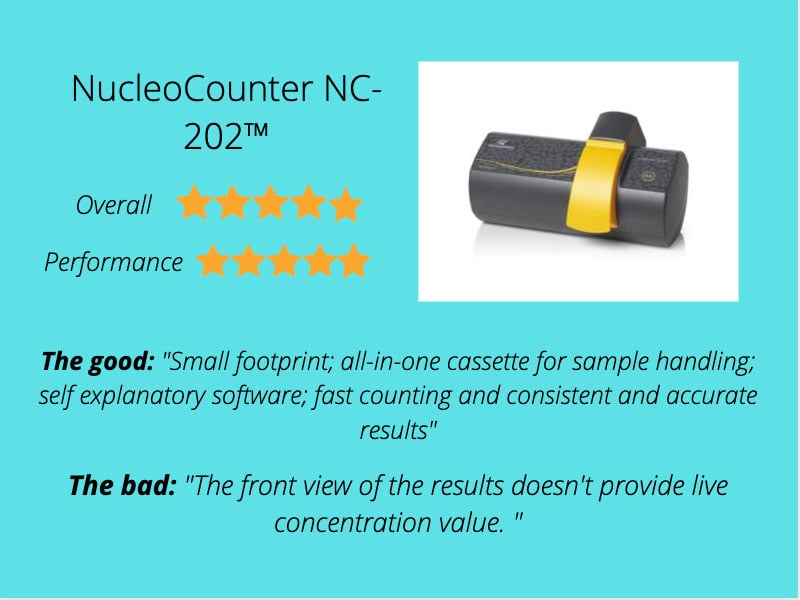 The third most popular automated cell counter was the NucleoCounter from ChemoMetec™, which has also received positive reviews consistently. Yibing Wang, research scientist at Abbvie, wrote that the cell counter has “fast counting and consistent and accurate results.” As for areas of improvement, they mentioned that “To reload the data, it's not instantaneous. The software tends to behave as if it has frozen for two to three second before there is any response,” and also that “It may take some time to figure out how to put the cassette into the measuring slot. A video instruction on using the machine would be nice.”
 While the Cellometer Auto Bright Field Cell Counter from Nexcelom Bioscience has only been reviewed once. Aurora Fabry-Wood, a research scientist from Bennubio, gave it a five star review. She wrote, “I was using a hemocytometer, which was time consuming and I was not able to get an accurate spheroid count. The Auto 1000 increased my productivity and allowed me to accurately count spheroids.”
More information
To learn about other cell counters and additional equipment, visit our product reviews. If you're looking to learn more about the evolution of cell counters, consider reading Is It Time to Break Up with Your Hemocytometer? or 7 Tips to Improve Cell Counting Accuracy.