To analyze RNA, scientists seek the best samples—intact and plentiful. When that’s available, analysis is easier, but some situations require working with low volumes of sample or the RNA can be degraded. Various products and techniques can be used to get the best results from a variety of RNA samples, even archived samples that are formalin-fixed, paraffin-embedded (FFPE). The isolated samples can be used in many ways, including RNA sequencing (RNA-seq).
From New England Biolabs, Breton Hornblower—product marketing manager, RNA, genome editing, and synthetic biology—and G. Brett Robb—scientific director—teamed up to discuss this topic. “Customers are increasingly working with low-volume and damaged RNA samples.” Hornblower and Robb add, “For some time there have been numerous studies conducted on FFPE samples in translational research and the clinical setting, known to be particularly challenging due to varying RNA quality after extraction.” Plus, they point out that single-cell and massively automated large-scale sequencing studies benefit from improved performance with low-volume samples.
FFPE samples, for example, “are often used for gene-expression profiling of tumor tissue samples and other clinically relevant material,” Hornblower and Robb note. “There is a drive to sequence lower volumes of FFPE, even at the single-cell level, as well as freshly isolated cells.” Learning more about single-cell transcriptomes will reveal more about the biology of many diseases and fundamental biological processes.
Other experts also see the potential of single-cell studies. “Today, researchers and clinicians are analyzing gene expression of samples containing only a few thousand cells down to a single cell,” says Milan Dieris, product manager, bioanalysis at Macherey-Nagel. “Think about the impact of single-cell RNA-seq for basic biological research or—to give a more practical example—tumor-expression profiling from FFPE samples in clinical oncology labs.”
Such applications are worth pursuing. Moreover, it’s not just about the sample, but how it gets handled.
Selecting the samples
When there’s not much sample to start with, scientists use various techniques to capture the RNA. “When talking about small samples we’re talking about workflows involving, for example, flow cytometry or laser-capture microdissection, both often yielding small amounts of valuable sample,” Dieris explains. “These techniques are gaining importance as more and more researchers get access to the required instruments.” Scientists use these techniques in many ways, such as isolating RNA for the polymerase chain reaction (PCR) or RNA-seq. “Today, single-cell RNA-seq is widely used in basically any research field, from plant science to pharmacology,” Dieris adds.

To help scientists work with small samples, Macherey-Nagel developed its NucleoSpin RNA Plus XS. It is “our newest product for isolation of RNA from small cell or tissue samples,” says Dieris. “The benchmarks of this product are its extra small column design and the fast and reliable processing.” This platform comes with a column that removes genomic DNA and can even isolate RNA from single cells.
Image: The NucleoSpin XS spin columns are designed to allow an extra small elution volume, and they are designed to be used with Macherey-Nagel’s latest RNA and FFPE kits.
For archived samples, Macherey-Nagel created the NucleoSpin totalRNA FFPE XS. “Due to the fixation and paraffin-embedding of the sample, a special processing is required,” Dieris notes. “Our FFPE kits have a patented paraffin dissolver, avoiding the use of toxic xylene for this purpose.” He adds, “We use designated decrosslinking buffers and silica columns to achieve maximum RNA yields even from small and degraded samples.”
More from less
Too much ribosomal RNA (rRNA) in a sample can swamp the other RNAs, making it more difficult to examine, for example, the messenger RNA (mRNA). “rRNAs are extremely abundant, constituting 80 to 90% of total RNA,” says Hornblower and Robb. “Efficient removal of rRNA is critical to enable cost-effective sequencing of RNA samples, but this can be especially challenging with low-quality RNA—for example, FFPE RNA—and with low-input amounts.”
So, New England Biolabs developed the NEBNext rRNA Depletion kit for human, mouse and rat. These kits “employ the efficient RNase H method, as well as complete probe tiling of rRNA, thereby ensuring that even degraded rRNA is hybridized and subsequently removed,” Hornblower and Robb explain.
To work with ever smaller samples in sequencing, New England Biolabs offers the NEBNext Ultra II RNA library prep kits, which can work with as little as 5 ng of sample. For single-cell analysis, scientists can use the NEBNext Single Cell/Low Input RNA Library Prep Kit for Illumina sequencing platforms, and this works with as little as 2 pg of total RNA.
Five Expert Tips
- Work with the largest samples of RNA possible to simplify and improve the analysis.
- Take all possible precautions to prevent any further degradation of the RNA.
- Work with sterile technique and decontaminated equipment.
- For FFPE samples, consider commercial sample-prep kits before analysis.
- For RNA sequencing from single cells, use a technique that works with the smallest possible amount of starting material.
Don’t degrade
Instead of finding ways to work with a degraded sample, some labs work to prevent degradation in the first place. As Daniel Schoenberg, professor of biological chemistry and pharmacology at Ohio State University, says, “As an RNA research lab, we take steps to avoid having degraded samples.”
In Schoenberg’s lab, all buffers that don’t contain Tris are treated with diethyl pyrocarbonate (DEPC), autoclaved and handled under sterile conditions. “Gloves are worn all of the time, only virgin plasticware is used and that is autoclaved prior to use,” he says. “Any gel boxes or equipment that will touch RNA is decontaminated by immersion in 1 M NaOH followed by extensive rinsing with deionized water.” The water for solutions is deionized water that is processed through EMD Millipore’s Synergy Water Purification System with a Biopak polisher at the exit port. “We also do not use RNase A, ever,” Schoenberg says. “If we need to use a ribonuclease, for example to study an RNA-binding protein, it is micrococcal nuclease since that requires calcium for activity and is inactivated by EGTA.”
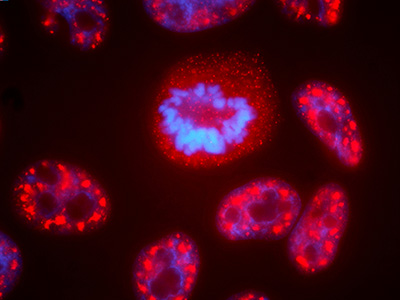
Image: The human nucleus contains RNA-processing proteins (red) near the chromosomes (blue), and scientists keep digging deeper into RNA’s role in healthy biology and disease. Image courtesy of Steve Mabon, Tom Misteli, NCI Center for Cancer Research, NIH.
At Cornell University’s College of Veterinary Medicine, assistant professor Charles Danko has worked with degraded or low-volume RNA samples. He says that the main challenges are “handling it in ways that you do not lose sample during each step.” Consequently, he says, “So far, we’ve largely tried to start with more material.” He adds, “We are experimenting with additional library-prep strategies that should be more forgiving as well.”
Finding the most forgiving ways to work with all RNA samples could be the key to better results. Undoubtedly, RNA still has lots to teach us about biology and disease.