In all areas of biomedical research, assays are fundamental tools that enable the successful discovery of molecular targets, potential medicines, and more. Much of today’s medical research and treatment depends on the ability to identify and measure specific analytes at very low levels of detection. Consequently, designing an assay that is robust, sensitive, and specific is crucial. In addition, today’s biomedical tools must handle large amounts of data. Meeting all of these demands requires an orchestrated effort that synthesizes many technologies and methods.
“Today’s assay technologies, including multi-parallel sequencing, quantitative high-throughput screening, library exploration, phenotype screening, and product library exploration, result in large quantities of data,” says Kristina Klette, market segment and application sciences manager at Hamilton Robotics. “While there is a significant time investment in optimizing assay conditions, high-throughput automation is creating a bottleneck for big-data processing and analysis.”
So, building modern biomedical assays depends on combining the capabilities from a range of disciplines. “Advancement in computational biology and artificial intelligence—especially in sequencing or high-throughput technologies—are beginning to provide a platform that harnesses the mountains of data generated in biomedical research, and reduces the time it takes to optimize workflow conditions,” Klette explains. “At the same time, computational biology is helping to predict a baseline-like model of a biological system, and remove variability among different assay chemistries so that the path to accurately understand, analyze, and treat disease states becomes more clear and effective.”
Biomedical assays arise from a range of technologies, including automation, computation, and molecular biology. Some of tomorrow’s most creative assays will surely involve CRISPR gene-editing technology.
Creating with CRISPR
“CRISPR technology has the potential to transform the fields of antibody engineering and hybridoma technology,” says Woei Tan, senior staff scientist and multiplex immunoassay developer of the Bio-Plex product line at Bio-Rad. Hybridomas are engineered cells that produce a specific antibody, and editing genes can be used to finetune the antibody’s target.
As Tan says, CRISPR “enables fast and simple editing of immunoglobulin genes in human and mouse.” That can be used “to produce a homogeneous antibody conjugate with site-specific modification from a plug-and-play hybridoma platform, and it will open new doors for the development of highly specific, next-generation high-throughput immunoassays for the study of complex diseases and to assist with drug and vaccine discovery.”
Many of the antibodies used in today’s assays could benefit from a DNA tweak or two. That’s the very thing that CRISPR can do, and relatively easily. “As the CRISPR-Cas9 editing technology continues to evolve, the implication for the technologies involved in antibody production will be profound,” Tan notes. 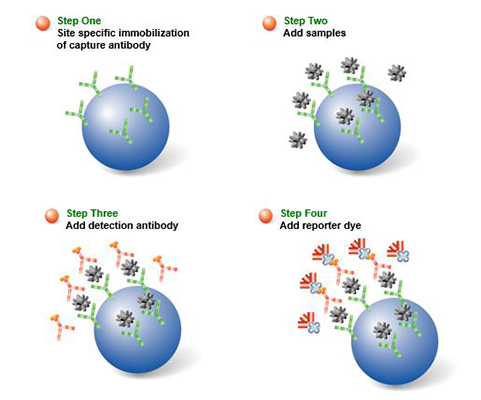 “The availability of low cost, site-directed, modified antibodies will permit the development of highly specific and tailored immune-conjugates for various immunoassay platforms, including multiplex assays.”
Scientists use antibodies for detection and labeling in many biomedical assays. Image courtesy of Bio-Rad.
No advance in technology, though, is ever flawless, and CRISPR is no exception. In some cases, CRISPR could create antibodies that hit more than the intended target, and these off-target effects could confound the results from an assay. In addition, the process needs to be faster and scaled up more easily. “This technology has to evolve to a stage where it can be used to reproducibly fast track the production of an antibody in weeks, instead of months, and can be conveniently adapted to the needs of a standard research laboratory as well as the demands of industrial production,” Tan says.
Automation and computation
Advances in computational biology and bioinformatics already speed up many processes involved in building a biomedical assay. “For example, where once it took researchers weeks to optimize assay conditions for something like PCR-based pathogen detection, it now takes an algorithm a fraction of the time,” says Michael Mouradian, director of robotics at Hamilton Robotics.
Advances in computational biology and bioinformatics already speed up many processes involved in building a biomedical assay.
The accuracy that can be added to an assay through computation is well worth the investment. As Mouradian points out: “Removing trial-and-error, and even subtle sources of variance, during assay optimization helps to ensure the most accurate, high-quality data, even in multiparameter, multivariant analysis.”
To get the most out of computation, scientists need to build assays from large datasets. “The larger the population, the truer indication of a predicted behavior or an overall condition, whether it’s normal or disease states, or drug combinations or more,” Mouradian explains. “This is where computational biology, bioinformatics, and high-throughput automation really complement and enable each other.”
Biocompare’s Assay Kits Search Tool
Find, compare and review assay kits
from different suppliers Search
That is, automation helps scientists process more samples in less time and more consistently. Then, software and computational tools must make the most of the collected data. “As software speed and intelligence continue to improve, we’ll have to improve automation times, throughputs, and speeds as well,” Klette says. “It creates a great feedback loop of innovation to propel biomedical research forward.”
A variety of approaches to computation can be used in assays. At the School of Biomedical Engineering at Colorado State University, Fort Collins, associate professor Ashok Prasad says that he is working on “an assay involving cell imaging and machine learning.” This assay analyzes a cancer cell’s shape to determine features, such as a cancer’s level of invasiveness. These changes in shape might eventually be connected with genetic changes in cancer, which can generate multiparametric assays to give researchers and clinicians more information about a patient’s cancer and, possibly, how it responds to treatment.
Phone it in
At the University of South Florida in Tampa, associate professor of chemical and biomedical engineering Anna Pyayt incorporates cellphones into biomedical assays, such as the analysis of body fluids. “One of the main applications we were targeting was the detection of preeclampsia—a dangerous pregnancy complication,” Pyayt says. “One of the symptoms is a presence of protein in urine.”
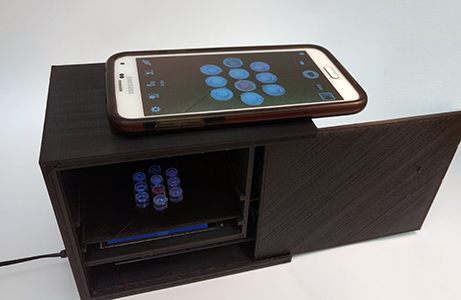 Pyayt and her team have also coupled a cellphone with ELISAs. “It is one of the most important technologies for biochemical analysis, critical for diagnosis and monitoring of many diseases,” she notes. “Traditional systems for ELISA incubation and reading are expensive and bulky, thus they cannot be used at point-of-care or in the field.” Pyayt’s lab developed a cellphone-based ELISA that runs the entire process, from incubation through analysis. Currently, this assay tests for progesterone, but Pyayt adds, “it can be used for any other ELISA-based test.”
A cellphone can be implemented in biomedical assays of many sorts, such as ones based on ELISA-based tests. Image courtesy of Anna Pyayt, University of South Florida.
As we’ve seen, tools from communication to computation and more can enhance biomedical assays. Plus, these assays extend from research applications to the clinic, and even a patient’s home. The key feature arises from the right mix of methods and technology. An assay is only as good as it’s accuracy and the data that it generates.
Building a custom assay
In 2003, ProteoGenix started providing scientists with—among other things—custom assays that can be used in the development of biotherapeutics. These assays can be built into a variety of formats, such as a Sandwich ELISA. “One strength is that the customer can come with almost nothing,” says Philippe Funfrock, co-founder and president of ProteoGenix. Starting from just a protein sequence number from the U.S. National Center for Biotechnology Information (NCBI), a customer receives a turnkey assay, along with samples of the antigen and antibody that were developed. Then, a customer only pays the full price if the assay works as desired. The customers are usually from biotechnology and pharmaceutical companies, but some come from academia.
“At the very beginning, we think about the ideal strategy to develop a specific assay, like the required sensitivity, specificity, and so on,” says Funfrock. “That drives the entire process.” From start to finish, ProteoGenix usually develops an assay in about 10 months. “That includes developing, producing, and purifying antibodies from at least 10 clones and testing all of the combinations to see which ones give the best signal, the best affinity,” Funfrock explains.
In fact, many steps and elements must be considered to develop the most effective assay. For example, various clones can be used to make an antibody, “but each clone has different properties that could fit different purposes,” Funfrock notes. Similar issues arise with the organism used for expression and so on. “We first strategically define the best process to develop the most appropriate tools” Funfrock says, “and then we have all of the solutions to perform that resulting in a high success rate.”