
At the heart of any molecular biology application is the genomic starting material.
DNA purification is therefore a critical procedure that can define the outcome and success of downstream molecular experiments.
In most cases, before any researcher can begin a PCR reaction, clone a gene, or construct a sequencing library, DNA must first be extracted from the relevant sample and purified.
Ideally, the purification should be conducted efficiently, with minimal steps to reduce the likelihood of error, yet still yield ample, high-quality DNA free of contaminating cell debris, protein, and RNA.
Traditional DNA extraction methods, such as phenol-chloroform extraction, can be time-consuming and subject to user variability.
In contrast, DNA purification kits contain quality-controlled components along with a standardized protocol to help ensure high-quality and reproducible yields.
Here, we present a comprehensive catalog of DNA purification kits listed by many leading suppliers, as well as a guide to help in the selection process.
How do DNA purification kits work?
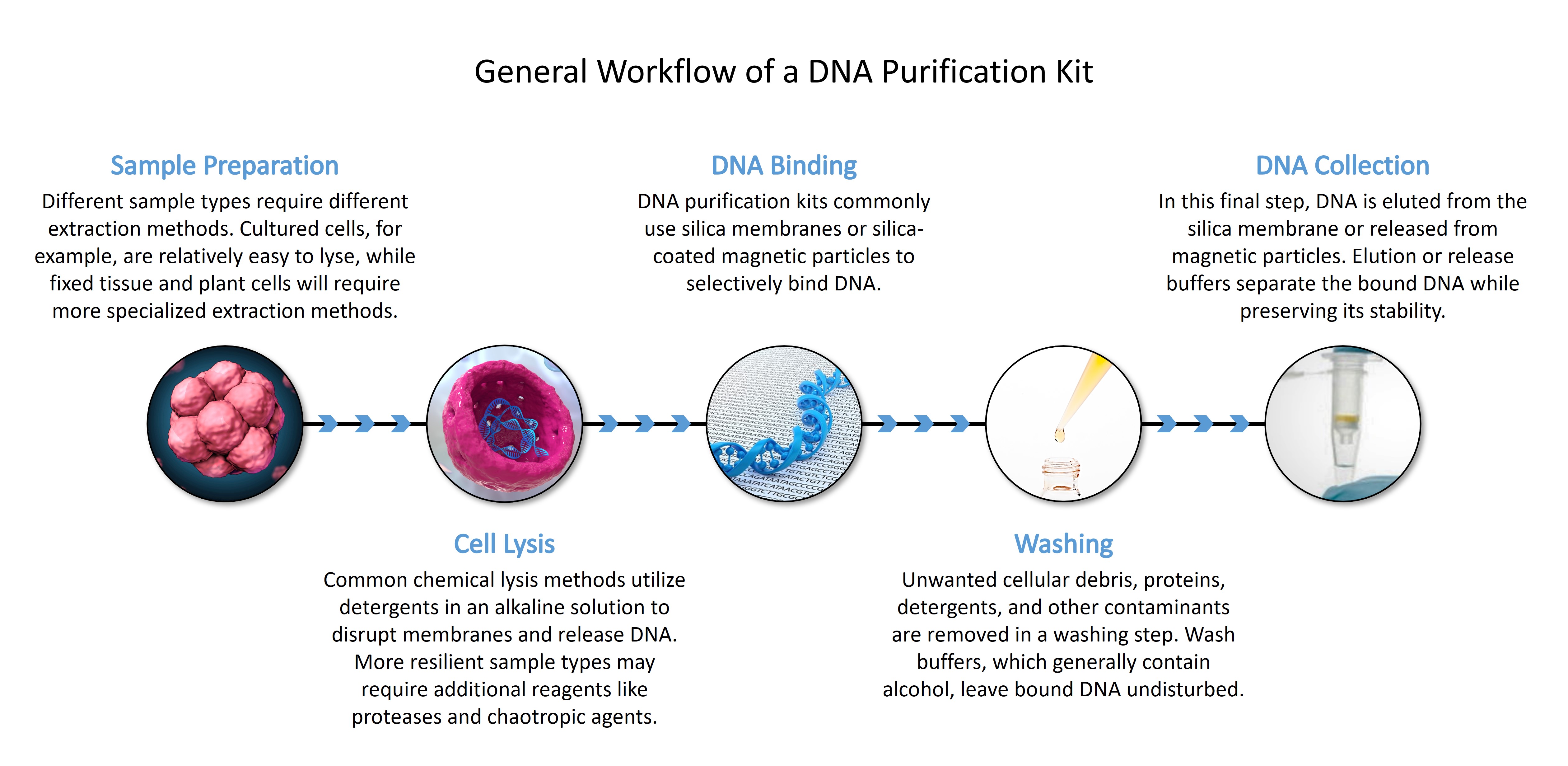
DNA purification kits generally function through a series of steps designed to break down cell components, bind the DNA, remove contaminants, and elute purified DNA.
While different kits can vary in their protocols depending on the type of sample (e.g., tissue, blood, cells) or the specific method used (e.g., silica-based, magnetic beads), the general workflow remains consistent.
Extraction begins with the addition of a lysis buffer that breaks apart the cell membrane.
This buffer generally contains: detergents (like SDS or Triton X-100) to disrupt lipid structures, salts to stabilize the DNA, and proteases to degrade proteins.
In silica-based kits, the lysed sample is passed through a spin column containing a silica membrane, which preferentially binds DNA and allows contaminants to pass through.
Meanwhile, magnetic-based kits utilize magnetic beads coated with DNA-binding material (such as silica).
A magnet is used to collect the beads, allowing contaminants to be washed away while DNA remains immobilized in solution.
A washing step ensures that any remaining proteins, lipids, and RNA are washed away, leaving only the bound DNA behind.
Finally, an elution buffer is used to release the immobilized, purified DNA for final collection.
What are the DNA types that can be purified?
DNA can be categorized based on physical characteristics, cellular location, or source of extraction.
Here are some examples of common DNA types that are purified for downstream use:
- Genomic DNA - Genomic DNA, or gDNA, is the entire chromosomal genetic material of a given cell, tissue, or organism. gDNA isolation is an important initial step for collecting material for many molecular biology applications such as library construction and sequencing.
- Plasmid DNA - Plasmid DNA, stored and propagated in competent bacterial strains, are essential in molecular cloning and gene expression. Many plasmid purification methods take advantage of their small and circular physical characteristics.
- Tissue DNA - In contrast to bacterial cells, eukaryotic cells and tissues are structurally more complex. Some tissue samples, like blood and fixed tissue, can pose technical challenges for DNA extraction.
- Mitochondrial DNA - The isolation of mitochondrial DNA (mtDNA) is an important first step for molecular investigations in mitochondrial genomics and gene expression.
- Cell-free DNA - Cell-free DNA (cfDNA) are fragments of extracellular DNA that freely circulate in the bloodstream. The isolation and identification of cfDNA is important in biomarker discovery and cancer research.
- PCR products - DNA fragments resulting from PCR amplification are known as PCR products. Prior to downstream applications, these DNA can be purified from the PCR reaction mixtures or agarose gels after electrophoresis.
Considerations for choosing a DNA purification kit
Use the appropriate kit for the sample type.
Different sample types will require different approaches to effectively purify DNA from contaminating components.
Some samples, such as cultured bacterial or mammalian cells, are relatively easy to lyse, while fibrous tissue, microbe cell walls, or plant cells require particular chemicals, enzymes, or techniques.
Kits designed for blood samples may include reagents to deal with serum proteins and hemoglobin, while those for plant tissues need buffers that handle cell walls, polysaccharides, and secondary metabolites.
For formalin-fixed paraffin-embedded (FFPE) tissues in which proteins and nucleic acids have undergone extensive cross-linking, special adaptations need to be incorporated, including deparaffinization.
Decide on a format.
Silica and magnetic-based are among the most common formats utilized by DNA purification kits, and each will offer unique advantages.
Silica membrane-based kits, which often use spin columns, are widely used for their simplicity.
These are ideal for manual, small-to-medium scale extractions that yield high-purity DNA suitable for most downstream applications.
Magnetic bead-based kits, which use magnetic separator devices, come in both tube or multiwell plate-based formats.
Plate-based magnetic DNA extraction kits are generally compatible with high-throughput or automated systems, making them ideal for screening and large-scale experiments.
Over the longer term, users should also consider overall cost sustainability in addition to ease of use.
Review the protocols.
Reviewing the protocols or product manuals when available can be helpful when deciding on a purification kit.
The protocol will reveal useful information, such as the complexity of the steps, total processing time, and any special equipment required (e.g., centrifuges, vacuum manifolds, or magnetic stands).
It can also dictate whether the kit is compatible with the sample type, what is the expected amount of DNA yield, and if additional processing will be required for downstream applications.
A well-suited protocol should balance efficiency with ease of use, saving you time while ensuring high-quality DNA extraction that meets the requirements of your specific experiment.
References
Smith, C. Improving DNA Extraction for NGS. Biocompare. 2021 Sep 15 [cited 2024 Sep]. Available from: www.biocompare.com/Editorial-Articles/579259-Improving-DNA-Extraction-for-NGS/
May, M. Efficiently Extracting Nucleic Acids. Biocompare. 2020 Jul 7 [cited 2024 Sep]. Available from: www.biocompare.com/Editorial-Articles/565643-Efficiently-Extracting-Nucleic-Acids/
Mitchell, D. Guide to Nucleic Acid Purification. Biocompare. 2022 Feb 3 [cited 2024 Sep]. Available from: www.biocompare.com/Editorial-Articles/582779-Guide-to-Nucleic-Acid-Purification/
Smith, C. Extracting Nucleic Acids from FFPE Tissues. Biocompare. 2023 Jan 6 [cited 2024 Sep]. Available from: www.biocompare.com/Editorial-Articles/585748-Extracting-Nucleic-Acids-from-FFPE-Tissues/
Recommended Reading:
With the advent of new therapies that rely on pDNA, demand is expected to rise, and, as such, this article will conduct a timely overview of recent advances in pDNA production processes that are helping to increase pDNA yields as well as the steps that are needed to ensure quality, safety, and efficacy.
There are a lot of plasmid prep kits in the market to choose from. To help provide some insight, we took a look at what kits our Product Reviewers have used and summarized their findings here.