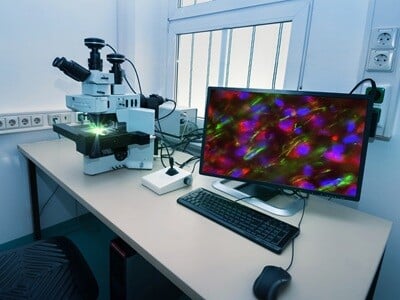
 Within a tissue, individual cells of the same type may behave differently based on variations in their microenvironment. Thus, location is key to understanding biological mechanisms, especially when it comes to differences between pathological and physiological phenomena. Naturally, there is a growing trend towards spatial biology, especially in areas such as cancer biology and immunology. Microscopy techniques let researchers track proteins and other biomarkers at single-cell resolutions to better understand the spatial landscape.
In this guide from Leica, discover how light and electron microscopy (EM) technologies are evolving to support the need for even greater spatial context.