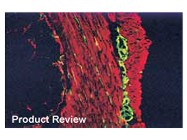
The Mouse-on-mouse (M.O.M.) Kit was developed to eliminate high background staining on mouse tissue sections when using mouse derived monoclonal or polyclonal antibodies. This background staining derives from the detection of IgG by the secondary antibody: it recognizes the tissue’s endogenous mouse IgG as well as the applied specific primary monoclonal or polyclonal antibody against a desired antigen. This background staining obscures the specific expression pattern of antigens.
To reduce this problem, Vector Laboratories developed the M.O.M. Basic Kit; this kit contains specific blocking reagents (M.O.M. protein concentrate and mouse blocking reagent), a biotinylated anti-mouse IgG reagent and a special staining procedure. The kit contains enough reagents for blocking 250 slides. Since the kit only provides the blocking reagents and the biotinylated antibody, the investigator is able to choose the detection method (e.g. peroxidase or fluorescent-based detection).
I used the kit for staining mouse brain and spinal cord frozen sections. Since some of the antibodies were mouse monoclonal antibodies, I was very happy that this kit was developed. I always used control slides in parallel with my staining slides; with my control slides, I eliminated the primary antibody so I could monitor whether the final staining was specific to my primary antibody. None of my antibodies generated non-specific antigen staining when using this kit and the following instructions.
Frozen slides were thawed, fixed in ice-cold acetone and/or methanol and washed in PBS (5 min). The endogenous peroxidase was quenched by incubation of the slides in PBS with 0.3% hydrogen peroxide and 0.3% horse serum. After 2 washes (each 2 min) in PBS, the slide was dried around the tissue section and marked with a Pap pen to reduce the antibody volume needed for staining. The tissue section was incubated for 1 h at room temperature with M.O.M. IgG blocking reagent (2 drops of reagent in 2.5 ml of PBS). After additional washing in PBS the M.O.M. diluent (600 µl of protein concentrate in 7.5 ml PBS) was applied for 5 min. The diluent was removed and the section incubated with the primary antibody in M.O.M. diluent for 30 min. The sections were washed again with PBS (2 x 2 min) and exposed to the diluted biotinylated anti-mouse reagent (10 µl stock in 2.5 ml of M.O.M. diluent) for 10 min, followed by 2 washes in PBS (2 min). For incubation with streptavidin-HRP (1 h), the Vectastain ABC Kit (Vector Laboratories) was used according to the manufacturer’s instructions. Detection was performed with the DAB kit from KPL, which results in a brown precipitate for specific staining, but none or only a slightly brownish staining on the whole tissue section.
For staining mouse tissue sections with monoclonal and sometimes polyclonal antibodies, I recommend the M.O.M Kit, since it efficiently reduces background and non-specific staining. Vector Laboratories also offers two other M.O.M. Kits with detection reagents included: the Peroxidase Kit with ABC Streptavidin-HRP Reagent and the Fluorescent Kit with Fluorescein Avidin DCS. All the brochures and troubleshooting guides for the M.O.M Kits are provided online.