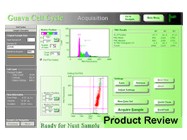
The Guava Cell Cycle is a module within the Guava Cytosoft suite, a program bundled with their personal cell analysis systems. As the name suggests, the program allows you to conduct flow cytometric cell cycle analysis. My experiences are with the version of the module that is bundled with the PCA 96 system. Coupled with this software, I used the PCA 96 system to evaluate the cell cycle stages of MG-63 human osteosarcoma cells which had been serum starved or treated with mitogens for 24, 48 or 72 hrs. Specifically, I used the intuitive software to quantify shifts in the percentage of cells that were actively proliferating (S/G2/M phase) versus those in growth arrest (G0/G1) following the various treatments over time. As with other Guava modules, the cell cycle module is designed to be an intuitive alternative to more complicated procedures on conventional cytometers. Coupled with extensive support literature, the module allows easy cell cycle analysis for users inexperienced with flow cytometer-based protocols.
The key to success with this particular module is optimized sample preparation. Guava technical support are able to offer a range of advice to help appropriately design the best staining protocol for your cells of choice. Literature searches and performing trials with your own cells to determine a standardized protocol will be well worth the investment of time if you plan to make cell cycle analysis a routine assay with your cells. Using a good cell dissociation agent, proper fixative steps, a decent staining buffer and a PI solution that includes RNase will make the assay a lot simpler and trouble-free.
Once the sample has been appropriately prepared, sample processing and data acquisition are relatively simple. Like with other modules, users follow a series of setup screens aimed at adjusting the cytometer settings to best suit your cells. Once this is complete, assay acquisition is automatically processed according to your pre-programmed sample selection. As the Guava PCA 96 can process up to 10 samples in eppendorf tubes, or an entire 96 well plate, data acquisition for many samples is fully automated once the initial set up is complete.
The module loads a “dashboard” during acquisition which already has the necessary parameters pre-loaded. On screen will be dot plots, histograms and histogram statistics of your acquisitions, as well as the necessary gating selection required to mark G0/G1, S and G2/M populations as necessary. All that is required of the user is to drag the marker over the appropriate populations and the software calculates the rest automatically. The data acquired should be suitable for most users. As with all Guava modules, the data can be exported to a spreadsheet or third party software for more advanced analysis.
While this particular module is well-designed, take caution in selecting an instrument simply because of the ease of use of the software. Depending on the range of flow cytometry experience and needs in your lab, there are design flaws in the Guava hardware that must be compared to traditional flow cytometers before selecting it for use in your lab. These issues are covered in a separate review, but are generally concerned with robustness of the system, particularly in terms of the capillary. As the cells are fixed for cell cycle analysis and acquired in a dissociation buffer, there is usually less of a problem with cells clogging the capillary with this module in comparison to other protocols with live cells. However, PI does stain the capillary and you will need to clean this out yourself.
PhD Student
School of Biomedical Sciences
University of Queensland