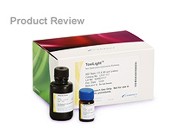
The ToxiLight® kit is a simple, quick and effective assay to measure cell death and cytotoxicity of adherent or suspension cultures. The assay is based on the measurement of the release of Adenylate Kinase (AK) following a loss of cell membrane integrity. My personal experiences have been limited to adherent cells, namely human mesenchymal stem cells and MG-63 human osteosarcoma cells. Following the manufacturer’s instructions, I sampled media from cells grown in 96-well plates as well as larger cultures such as 12- and 6-well plates. I found the assay particularly useful in drug dose-response proliferation assays. I would use the cell layer to quantify DNA content (as an indirect measure of proliferation) and then sample the media to determine if the same drug doses were inducing cell death.
The assay can be conducted on cells cultured directly in luminescence compatible 96-well plates or on media aliquots taken from larger cultures. After reaching room temperature, the media (free from cell debris) can be used immediately in the assay or stored frozen for analysis later. Samples are mixed with the reconstituted AK detection reagent, incubated for 5 minutes and the plate is then read in a luminescence compatible plate reader. The assay reagent is provided in the kit and therefore, no additional buffer preparation is required. Furthermore, the detection reagent is stable for 6 hours at room temperature, for 24 hours at 2-8ºC and longer if it is aliquoted and stored at -20ºC.
The assay is highly sensitive and, as it is based on luminescent measurements, has a large linear range. Furthermore, media constituents including fetal calf serum or pH indicators do not interfere with the readings, which allows readings to be taken from cultures with full serum supplementation. This is a significant advantage over competitor products. Accuracy is maintained as long as all reagents (including samples) are always allowed to reach room temperature before the assay is conducted. As little as 20 l of media can be used from a single sample, allowing for high-throughput screening of cytotoxic agents or drug candidates in 96-well or even 384-well format.
As the assay is conducted on harvested media, it is also possible to use the cell layer for other assays, such as measurements of cell number which can be used to standardize assay results. This is especially important over longer assay periods when cytotoxic agents act early, preventing cell growth. For example, control cultures, lacking an inhibitor of growth, proliferate at a much faster rate and will have lower percentage cytotoxicity, but a high cell number and therefore, a potentially higher net assay reading than a culture with a high percentage cytotoxicity and lower cell number. A good positive control is a culture treated with 10% triton-X-100 media to achieve 100% cell lysis. This also allows positive readings from your samples to be placed in the context of 100% lysis.
The only major drawback is that a luminescence compatible device is required to measure the assay, along with luminescence compatible plates or cuvettes. In addition, if cell death is a major focus of your research, you may find it appropriate to confirm this indirect measure of cell death with more direct measurements of cell death (such as a flow cytometer-based live/dead assay).
PhD Student
School of Biomedical Sciences
University of Queensland