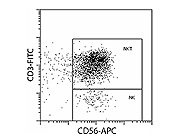
Miltenyi’s CD3+CD56+ NKT Cell Isolation Kit is used for magnetic separation of CD3+CD56+ NKT cells from human peripheral blood mononuclear cells (PBMCs). Since NKT cells display a rare cell set of cell surface markers, a two stage magnetic labelling system is required. In the first step, NKT cells are enriched by depletion of non-CD3+CD56+ NKT cells. A cocktail of biotin-conjugated monoclonal anti-human antibodies directed against antigens not expressed by NKT cells is added to the PBMC suspension. After addition of MicroBeads conjugated to monoclonal anti-biotin antibodies, the labelled cells are subsequently depleted by magnetic separation over a Miltenyi LD column. In the second step, the flow-through fraction of pre-enriched CD3+CD56+ NKT cells are tagged with MicroBeads conjugated to monoclonal anti-CD56 antibodies. In presence of the magnetic field, non-labelled cells do not bind to an MS column. NKT cells are retained on the column and then eluted outside of the magnetic field. The kit includes 2 ml CD3+CD56+ NKT Biotin-Antibody Cocktail, 2 ml Anti-Biotin MicroBeads and 2 ml CD56 MicroBeads, sufficient for 2 x 10⁹PBMCs or up to 20 separations. The kit can be used at least 7 months, if properly stored at 2-8°C.
Isolating rare cell populations from human blood or PBMCs can be quite challenging, especially if only a limited amount of material is available. Miltenyi’s CD3+CD56+ NKT Cell Isolation Kit offers a competitive method to isolate NKT cells from human PBMCs with great yield and satisfactory purity. We routinely measure the fraction of NKT cells in PBMC preparations by fluorescence activated cell sorting. About 80 to 90% of NKT cells can be recovered after complete purification, which is enough for our major downstream application, RNA isolation. Purity ranges between 70 and 85%. The protocol is easy to follow. The complete procedure including washing steps and incubation times takes between 95 and 110 minutes. In our hands, we found that only the LD and MS columns guarantee the yields and purities stated above, use of LS columns will lead to significant loss of cells and higher numbers of contaminating cells. Since only up to 20 separations can be accomplished with one kit and comparatively large amounts of antibodies as well as two different kinds of MicroBeads are needed, this product is relatively expensive.
PhD Student
Institute f. Med. Microbiology & Hygiene
University of Regensburg