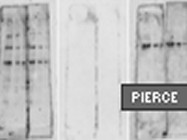
Standard published protocols routinely make note of the stripping and re-probing of Western Blot membranes, a technique that eluded me for many years. Even when I would use the standard beta-mercaptoethanol/SDS protocol, I saw residual background noise from the primary protein. A few years ago, I saw an advertisement for Pierce’s Restore Western Blot Stripping Buffer. As the product was available in a trial size, I figured I had nothing to lose and opted to try it out. As usual, I probed for my primary protein and was duly impressed to find no background signal after using the Restore Western Blot Stripping Buffer.
Efficient stripping of a blot is crucial if you wish to probe for two proteins that are closely related structurally or in molecular weight. In my case, I was probing for two separate proteins from cell lysates that were only 10 kDa apart. After separating cell lysates by SDS-PAGE, I ransfered the proteins to either nitrocellulose or PVDF membranes. Since I was using primary mouse antibodies for both proteins I required the blots to be stripped of both primary and secondary antibodies associated with the first protein. If the stripping of the membrane following detection of the first protein was unsuccessful, the second incubation with anti-mouse–horseradish peroxidase, would pick up both primary antibodies creating significant interference. I was pleasantly surprised to find that the signal for the second protein was not only easily detectable, but was virtually devoid of signal from the first protein. Stripping was successful on either nitrocellulose or PVDF membranes. Subsequently, everyone in my lab has been using Restore Western Blot Stripping Buffer successfully.
It is also important to have effective stripping of the membrane when probing for the phosphorylated form of a protein. In this situation, stripping is not crucial for probe accuracy, however, it saves time and lysate requiring only one gel. This is very useful when testing antibodies or optimizing antibody concentrations. Just use Restore Western Blot Stripping Buffer and then re-probe with a different antibody concentration. The stripping procedure itself is very simple, quick and effective. There is only one reagent used for blot incubation (15 to 30 minutes either at room temperature or 37C), though optimal antibody conditions must to be determined. Although the solution has a slightly unpleasant odor, it does not smell as bad as the classical beta-Me/SDS protocol. In addition, the solution is a gentle formulation that does not damage the target protein.
Roseanne Shoshana Greenberg
Graduate Student
Department of Ophthalmology
Mount Sinai School of Medicine, New York, NY