In a paper published last week in Nature Communications, a team led by University of California San Diego researchers describe the development of a new system for testing and developing gene drives in the laboratory and safely converting them into tools for potential real-world applications.
CRISPR-based gene drives feature Cas9 endonuclease and a guide RNA molecule that join forces to direct DNA cuts to specific sites in the genome where new genetic elements can be inserted. As the DNA repairs these cuts, the new genetic elements are copied from one chromosome to another, resulting in offspring that exceed the standard 50-50 percent inheritance, instead favoring the newly inserted genetic elements.
Gene drives come in two “flavors.” Full gene drives (fGDs) carry both the Cas9 and guide RNA components in a linked unitary package. In contrast, split drives (sGDs) consist of two genetic elements that separately carry the Cas9 and guide RNA components and are inserted at different sites in the genome. sGDs are considered to be safer than fGDs since it is possible to control and test the components carried by each of the elements separately or under conditions where they gradually amplify the frequency of the gRNA component.
In the case of eradicating malaria, full gene drives have created considerable enthusiasm due to their potential as vehicles to transfer elements that halt the transmission of malarial parasites that cause infection. But fGDs have also raised concerns due to their potential to rapidly spread and potentially alter the genetic makeup of entire mosquito populations. Experimenting with fGDs requires high-security barriers and restrictions to prevent unintended escape of insects carrying such drives into the open environment.
This is not the case with split gene drives. Because the key elements are separate, sGDs carry far less risk of unintentional spread and researchers hold much more control for their safe manipulation. Experiments with sGDs can be conducted in traditional lab facilities, thus allowing much more flexibility for testing their potential.
Scientists have been challenged, however, in developing systems that effectively convert sGDs into fully functioning fGDs. One challenge faced by current conversion of sGD systems into fGDs is that they rely on two separate genetic components, each of which must manifest efficient drive properties.
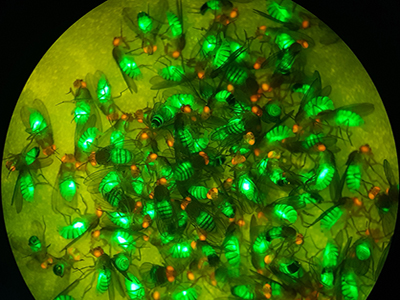
Fluorescent Flies: Fruit flies expressing red eye and green body fluorescent markers demonstrated the viability of a new system for safely converting split gene drives into full gene drives. Credit: Bier Lab, UC San Diego
Now, UC San Diego scientists have created a flexible genetic “hacking” system for converting sGDs into fGDs. Working in fruit flies, the researchers developed a novel genetic strategy that employs a specially designed guide RNA carried by the Cas9 part of the sGD. This hacking tool cuts the copying component of the sGD and triggers a genetic exchange, or “recombination event,” that inserts the Cas9 into the element carrying the guide RNA, resulting in the creation of a fully functioning fGD.
“First, and most importantly, the study provides proof-of-principle for the agile genetic conversion of an sGD into an fGD, which should greatly aid in the testing and development of new optimized gene-drive systems,” says Gerard Terradas, first author of the paper.