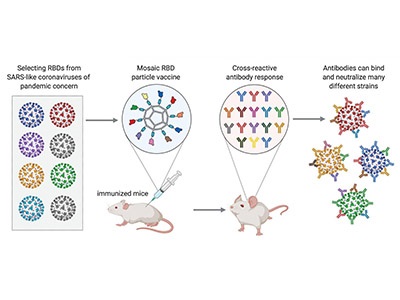
In a significant step toward a vaccine that simultaneously protects against SARS-CoV-2 and emerging zoonotic coronaviruses, a Caltech team has designed a protein-based 60-subunit nanoparticle onto which pieces of up to eight different types of coronavirus have been attached. When injected into mice, this vaccine induces the production of antibodies that react to a variety of different coronaviruses—including similar viruses that were not presented on the nanoparticle—according to a paper published in Science yesterday.
The vaccine platform used, called a mosaic nanoparticle, was developed initially by collaborators at the University of Oxford. The nanoparticle is shaped like a cage made up of 60 identical proteins, each of which has a small protein tag that functions like a piece of Velcro. The team took fragments of the spike proteins of different coronaviruses and engineered each to have a protein tag that would bind to those on the cage—the other half of the piece of Velcro. When these viral pieces were mixed together with the nanoparticle cage structure, each virus tag stuck to a tag on the cage, resulting in a nanoparticle presenting spikes representing different coronavirus strains on its surface.
Search Antibodies Search Now Use our Antibody Search Tool to find the right antibody for your research. Filter
by Type, Application, Reactivity, Host, Clonality, Conjugate/Tag, and Isotype.
Displaying eight different coronavirus spike fragments (receptor binding domains) with this particle platform generated a diverse antibody response, which is an advantage over traditional vaccine methods that present pieces from only a single type of virus. After inoculation, the antibodies subsequently produced by mice were able to react to many different strains of coronavirus. Importantly, the antibodies were reactive to related strains of coronavirus that were not present on the nanoparticle. This suggests that, by presenting the immune system with multiple different coronavirus variants, the immune system learns to recognize common features of coronaviruses and thus could potentially react to a newly emerging coronavirus—not just a SARS-CoV-2 variant—that might cause another pandemic.
Although the team is still studying the mechanism underlying this phenomenon, the results are promising. The next step is to examine whether immunization prevents viral infection and/or infection symptoms in animals making these antibodies.
Image: This new vaccine prototype works by attaching many protein fragments (specifically, receptor-binding domains or RBDs) to an engineered protein-based nanoparticle. The study, in mice, showed that the vaccine induced the production of antibodies that are broadly reactive to a wide range of coronaviruses. RBDs are particularly important for a virus to be able to infect a cell, so antibodies that recognize RBDs are likely more effective at preventing bad infections.