Duke University biomedical engineers have created a new way to reprogram stem cells into mature adult neurons by mastering the language of gene regulatory networks. Programming stem cells into other cell types is not a new idea. Several methods already exist, but often, programmed stem cells do not mature correctly when cultured in the lab, so researchers seeking adult neuron cells for an experiment might end up with embryonic neurons.
Using CRISP gene editing, the team created a method to identify which transcription factors were essential to making a good neuron. Their work, published today in Cell Reports, demonstrates the potential of the approach to make mature adult neurons, but it could be applied to program any cell type.
Using their method, the process from stem cell to mature neuronal cell took seven days, dramatically shortening the timeframe compared to other methods that take weeks or months.
Search Antibodies Search Now Use our Antibody Search Tool to find the right antibody for your research. Filter
by Type, Application, Reactivity, Host, Clonality, Conjugate/Tag, and Isotype.
Creating better cells will help researchers in a number of ways. Diseases like Alzheimer's disease, Parkinson's disease, and schizophrenia most often occur in adults and are difficult to study because making the right cells in the lab is challenging. This new method can allow researchers to better model these diseases and others. It can also help with drug screening, as different cells respond to drugs differently.
More broadly, the same method for screening transcription factor genes and gene networks could be used to improve methods to make any cell type, which could be transformative for regenerative medicine and cell therapy.
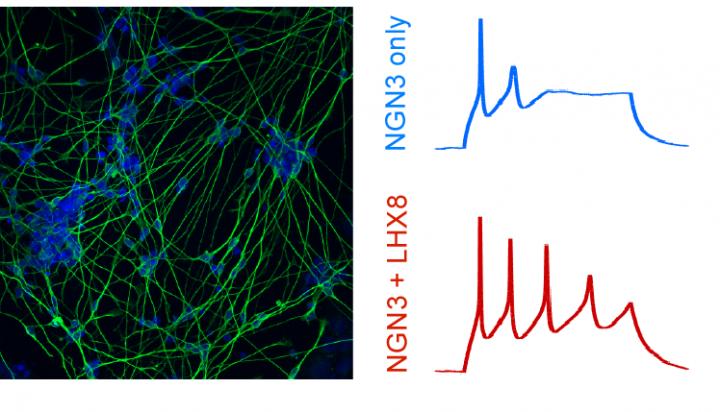
Image: CRISPR-based activation of gene networks implicated in human stem cells becoming neuronal cells led to the generation of cells with neuronal shapes and markers (left) and enhanced function and electrophysiological properties, including producing more action potentials more frequently (right).