Researchers have developed a human cell “membrane on a chip” that allows continuous monitoring of how drugs and infectious agents interact with our cells. The team says their device could mimic any cell type. Funded by DARPA, the research recently pivoted to how COVID-19 attacks human cell membranes and, more importantly, how it can be blocked.
The platform is described in two papers published recently in Langmuir and ACS Nano.
The device integrates cell membranes with conducting polymer electrodes and transistors. To generate the on-chip membranes, a group from Cornell University first optimized a process to produce membranes from live cells and then, working with a team from the University of Cambridge, coaxed them onto polymeric electrodes in a way that preserved all of their functionality. The hydrated conducting polymers provide a more 'natural' environment for cell membranes and allows robust monitoring of membrane function.
Coronavirus Research ProductsSearch Now Find the right products for your coronavirus-related research. Biocompare's Coronavirus Research Products category includes commercially available antibodies, ELISA kits, proteins, strains, and PCR assays.
Another part of the team, from Stanford University, optimized the polymeric electrodes for monitoring changes in the membranes. The device no longer relies on live cells that are often technically challenging to keep alive and require significant attention, and measurements can last over an extended time period.
"Because the membranes are produced from human cells, it's like having a biopsy of that cell's surface—we have all the material that would be present including proteins and lipids, but none of the challenges of using live cells," said Susan Daniel, senior author of the Langmuir paper.
"This type of screening is typically done by the pharmaceutical industry with live cells, but our device provides an easier alternative," said Dr Róisín Owens senior author of the ACS Nano paper. "This method is compatible with high-throughput screening and would reduce the number of false positives making it through into the R&D pipeline."
"The device can be as small as the size of a human cell and easily fabricated in arrays, which allows us to perform multiple measurements at the same time," said Anna-Maria Pappa, joint first author on both papers.
To date, the aim of the research, supported by funding from DARPA, has been to demonstrate how viruses such as influenza interact with cells. Now, DARPA has provided additional funding to test the device's effectiveness in screening for potential drug candidates for COVID-19 in a safe and effective way.
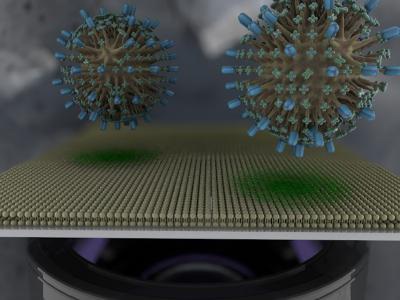
Given the significant risks involved to researchers working on SARS-CoV-2, scientists on the project will focus on making virus membranes and fusing those with the chips. The virus membranes are identical to the SARS-CoV-2 membrane but don't contain the viral nucleic acid. This way new drugs or antibodies to neutralize the virus spikes that are used to gain entry into the host cell can be identified.
Image: Researchers have developed a human cell 'membrane on a chip' that allows continuous monitoring of how drugs and infectious agents interact with our cells, and may soon be used to test potential drug candidates for COVID-19. Image courtesy of Susan Daniel/Cornell University.