One of the most destructive complications caused by SARS-CoV-2 is the massive release of proinflammatory cytokines, or a “cytokine storm,” leading to the acute respiratory distress syndrome (ARDS) in COVID-19 patients. In a study published yesterday in Immunity, Hokkaido University researchers proposed a possible molecular mechanism that could account for this cytokine storm.
ARDS is a life-threatening condition in which the lungs become so inflamed and filled with fluid that they struggle to provide enough oxygen to the body. “To rescue the patients from this condition, it is vital to understand how SARS-CoV-2 triggers the cytokine storm that leads to ARDS,” says senior author Masaaki Murakami.
Murakami, together with his collaborator Toshio Hirano from the National Institutes for Quantum and Radiological Science and Technology, reviewed two recent studies by Zhou et al. and Hoffmann et al. in order to understand their implications for finding effective therapeutic strategies for ARDS in COVID-19 patients.
Coronavirus Research ProductsSearch Now Find the right products for your coronavirus-related research. Biocompare's Coronavirus Research Products category includes commercially available antibodies, ELISA kits, proteins, strains, and PCR assays. Together, the studies suggest that SARS-CoV-2 enters human cells by attaching to a cell surface receptor called ACE2 and utilizing a human enzyme called TMPRSS2. “Drugs that block the ACE2 receptor or that inhibit the enzyme could help treat the initial stages of the disease,” Murakami explains. “However, ARDS with cytokine storm starts to appear in the later phase of infection even when the number of virus decreases. So, there must be another pathway that causes the cytokine storm.”
Current understanding is that the SARS-CoV-2 virus is engulfed into human cells along with the ACE2 receptor it binds to. Because of this, the number of ACE2 receptors on cells is decreased, which leads to an increase in angiotensin II in the blood. Angiotensin II then triggers an inflammatory pathway involving NF-κB and IL-6-STAT3, particularly in non-immune cells like endothelial cells and epithelial cells.
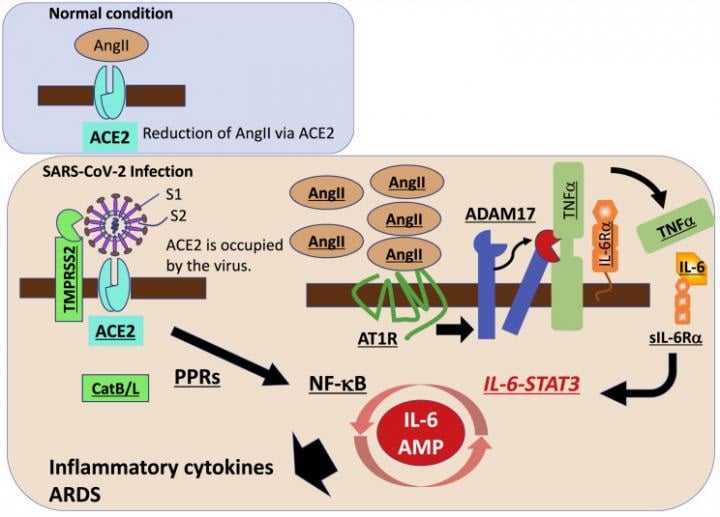
“This pathway forms a positive feedback cycle, named IL-6 amplifier, resulting in its excessive activation and therefore the cytokine storm and ARDS,” says first author Toshio Hirano. “Targeting these pathways, such as with the anti-IL-6 receptor antibody called tocilizumab, could disrupt this life-threatening inflammatory reaction in COVID-19 patients.”
Image: The proposed molecular pathways that lead to the acute respiratory distress syndrome (ARDS) in COVID-19 patients. Drugs targeting to the key molecules such as IL-6 receptor could disrupt the inflammatory reaction. Image courtesy of Toshio Hirano and Masaaki Murakami. Immunity. April 22, 2020.