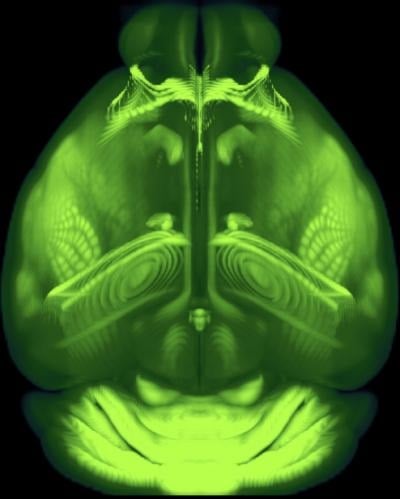
A high-resolution, 3D map of the whole mouse brain is now available. Created by scientists at the Allen Institutite, it is described in a paper published in Cell today.
The third iteration of the Allen Mouse Brain Common Coordinate Framework, or CCFv3, is meant to be a reference point for the neuroscience community, its creators said. Mouse brains contain approximately 100 million cells each across hundreds of different regions. As neuroscience datasets grow larger and more complex, a common spatial map of the brain becomes more critical, as does the ability to precisely co-register many different kinds of data into a common 3D space to compare and correlate.
"In the old days, people would define different regions of the brain by eye. As we get more and more data, that manual curation doesn't scale anymore," said Lydia Ng, Ph.D., one of the senior authors on the atlas paper. "Just as we have a reference genome sequence, you need a reference anatomy."
Search Antibodies Search Now Use our Antibody Search Tool to find the right antibody for your research. Filter
by Type, Application, Reactivity, Host, Clonality, Conjugate/Tag, and Isotype.
The whole-brain CCFv3 builds on a partial version released in 2016 that mapped the entire mouse cortex. Previous versions of the atlas were lower resolution 3D maps, while CCFv3's resolution is fine enough that it can pinpoint individual cells' locations. The latest full-brain atlas has been openly available for the community since late 2017, and several different neuroscience teams have already put it to use.
To make the atlas, the researchers broke up the brain into tiny virtual 3D blocks, known as voxels, and assigned each block a unique coordinate. The data that fed into that 3D construction came from the average brain anatomy of nearly 1,700 different animals. The team then assigned each of those voxels to one of hundreds of different known regions of the mouse brain, drawing careful borders between distinct areas. The datasets that fed into these two aspects of the atlas came from several different kinds of experiments conducted at the Allen Institute over the past several years—the atlas's backbone of different types of data makes it unique among reference brain atlases, the researchers said.
Historically, brain atlases were drawn in 2D, taking sheet-like views of the brain at different depths and lining them up. For some types of data, this form of brain mapping works well. But for modern neuroscience studies looking at neuron activity or cell characteristics across the entire brain, a 3D atlas gives better context.
The researchers said future iterations of the atlas will likely rely on machine learning or other forms of automation, rather than the laborious manual curation that went into the current version. "As we know now, atlases should be evolving and living resources, because as we learn more about how the brain is organized, we will need to make updates," Harris said. "Building atlases in an automatic, unbiased way is where the field is likely moving."
The Allen Mouse Brain Common Coordinate Framework (CCFv3), a 3D reference atlas, is based on an average of the inherent fluorescence in the brains of mice imaged using serial two-photon tomography. The image shows a semi-transparent top-down view of the average template, revealing many striking anatomical features.