Between 7% and 10% of the world’s population suffers from chronic pain—a disease that can be severely debilitating. In a study published today in EMBO Molecular Medicine, University of Copenhagen researchers developed a new way to treat chronic pain. Their treatment was successful in mouse models.
“We have developed a new way to treat chronic pain. It is a targeted treatment. That is, it does not affect the general neuronal signaling but only affects the nerve changes that are caused by the disease,” says senior author Kenneth Lindegaard Madsen. “We have been working on this for more than ten years. We have taken the process all the way from understanding the biology, inventing and designing the compound, to describing how it works in animals, affects their behavior, and removes the pain.”
Chronic pain can occur, among other things, after surgery, after a blood clot, and even after an amputation in the form of phantom pain. It also happens regularly in people with diabetes. The compound that the researchers developed is a peptide named Tat-P4-(C5)2; its effects are targeted and only affect the nerve changes that cause the pain.
Search Antibodies Search Now Use our Antibody Search Tool to find the right antibody for your research. Filter
by Type, Application, Reactivity, Host, Clonality, Conjugate/Tag, and Isotype.
In a previous study, the researchers showed in an animal model that use of the peptide can also reduce addiction. Therefore, the researchers hope that the compound may potentially help pain patients who have become addicted to, for example, opioid pain relievers in particular.
“The compound works very efficiently, and we do not see any side effects. We can administer this peptide and obtain complete pain relief in the mouse model we have used, without the lethargic effect that characterizes existing pain-relieving drugs,” Madsen says. “Now, our next step is to work towards testing the treatment on people. The goal, for us, is to develop a drug; therefore, the plan is to establish a biotech company as soon as possible so we can focus on this.”
The researchers are now working towards clinical trials.
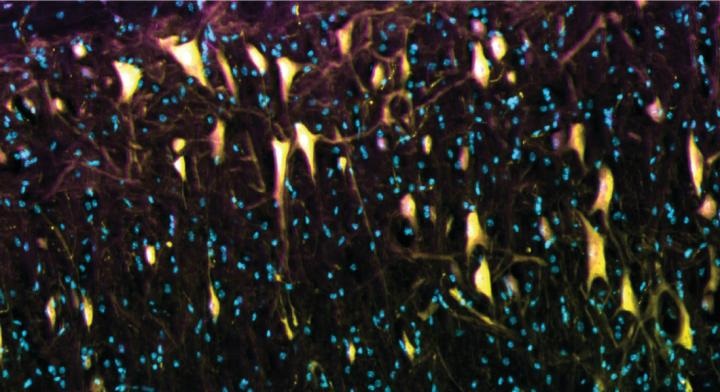
Image: The image shows the compound Tat-P4-(C5)2 after an injection into the spinal cord. The compound (purple) penetrates the nerve cells of the spinal cord (yellow), but not the surrounding cells (the cell nuclei are blue). Image courtesy of University of Copenhagen.