In a study published today in Nature, U of U and UCSF utilized an imaging system that allowed them to visualize the role of LEM2 in mitosis, giving us new understanding of the process. First, LEM2 creates seals in the protective coatings of newly forming nuclei that keep the two copies of DNA shielded from damage. Second, LEM2 recruits factors that disassemble the apparatus of fibers that are responsible for separating the two copies of DNA.
“Using our imaging methods, we were able to see a process that only occurs over the course of about five minutes during cell division, something that would have been very difficult to study otherwise,” says Dollie LaJoie of U of U.
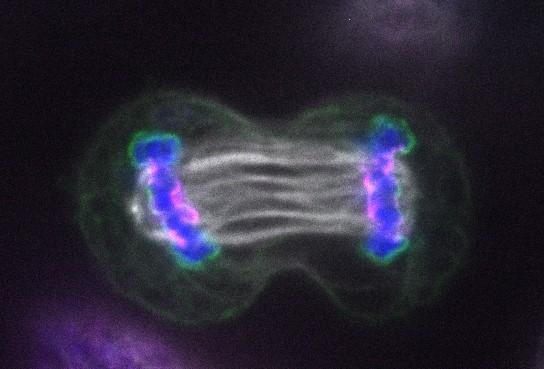
To visualize LEM2’s role in mitosis, the team used colored fluorescent markers to label the different components: LEM2, the fibers, and the DNA. This process allowed them to film LEM2 from when it first associates with intact fibers until the time of their disassembly. They observed LEM2 proteins concentrating and forming a gel-like seal with other proteins (ESCRTs) at holes where fibers traverse the protective coat of the nucleus. This LEM2 “O-ring” effectively sealed off the re-forming nuclear coat, safeguarding each set of DNA from material surrounding the nucleus.
Search Antibodies Search Now Use our Antibody Search Tool to find the right antibody for your research. Filter
by Type, Application, Reactivity, Host, Clonality, Conjugate/Tag, and Isotype.
“This work was strengthened by the fact that both teams worked on this project using different approaches to better explain the role of LEM2,” Katharine Ullman of U of U says. “My research group focused on this process in live cells while Frost’s research group worked to understand more about the protein itself.”
The authors note that this novel type of gel-like separation may prove important for other critical cell functions that LEM2 participates in, including higher-level DNA organization. They also showed that disruptions to LEM2 during its assembly of the nucleus resulted in DNA damage—which jeopardizes normal cell function.
"This work opens a door to identifying new pathways for DNA to be damaged, which in some cases may contribute to the development of cancer,” Ullman says.
Moving forward, the Ullman and Frost Labs will build on this work by investigating the connection between improper nucleus formation and DNA damage. They will examine how cancer cells may lack the proper regulation of both nuclear assembly and nuclear repair.
Image: To visualize LEM2's role in mitosis, the Ullman Lab used colored fluorescent markers to label the different components—LEM2, the fibers, and the DNA. Image courtesy of Huntsman Cancer Institute.