Spinal cord injury can be highly debilitating and affect motor skills, sensation, and autonomic brain functions. Additionally, it often leads to the development of spasticity, which manifests itself in involuntary sustained or rhythmic muscle contractions. But in a mouse study published yesterday in Science Translation Medicine, University of Copenhagen researchers identified a drug that can prevent spasticity from developing after spinal cord injuries.
“We show that nimodipine by and large can prevent the development of spasticity after a spinal cord injury if administered soon after the injury and for an extended period of time,” says coauthor Ole Kiehn.
The researchers guessed that spasticity would be blocked as long as their pharmacological treatment was ongoing. “But we were positively surprised to see that the development of spasticity remained blocked even after we stopped the pharmacological treatment,” says coauthor Carmelo Bellardita.
Search Antibodies Search Now Use our Antibody Search Tool to find the right antibody for your research. Filter
by Type, Application, Reactivity, Host, Clonality, Conjugate/Tag, and Isotype.
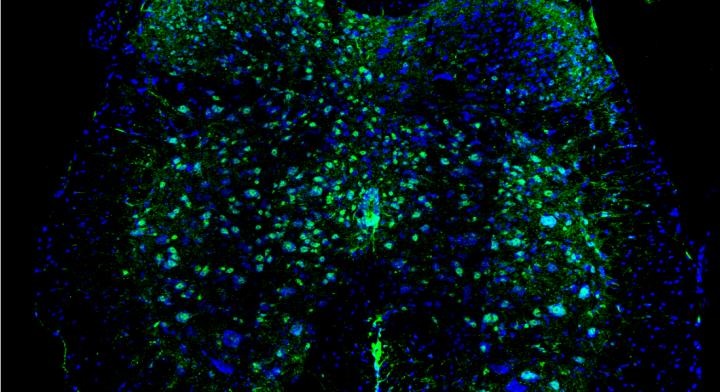
Nimodipine is a drug that has already been approved to treat high blood pressure, among other things. It works by blocking the L-type calcium channels that are found in many nerve cells in the spinal cord. In the study, the researchers show that the effect of nimodipine is due to the blocking of one specific L-type calcium channel, the so-called CaV1.3 channel. When they genetically removed the CaV1.3 calcium channels in mouse spinal cords, they achieved the same result: the blockage of spasticity development.
The results could potentially also be relevant to other diseases where spasticity may develop, including multiple sclerosis and stroke. However, further experiments will be required to determine whether nimodipine will have the same effect on human spasticity.
“We are quite optimistic that nimodipine will have the same effect in humans. But we cannot be certain,” Kiehn says. “Nimodipine is an approved drug that easily enters the brain, and we will now begin trials together with other researchers where we test nimodipine on healthy test subjects to study the effect on various reflexes and motor skills. Subsequently, it may potentially be possible to test the drug on people with spasticity.”
Image: An image of a spinal cord from a mouse where the Cav1.3 channels in the nerve cells glow green. Image courtesy of Kiehn Lab, University of Copenhagen.