Heart failure affects around 23 million people worldwide each year, and there is currently no cure. After a heart attack, an adult human heart can lose up to one billion heart muscle cells. Unlike many other organs in the body, the adult heart can’t regenerate itself, so these cells are never replaced. Their loss reduces the strength of the heart and causes scar formation, heart failure, and ultimately death.
However, a study published today in Nature Communications has opened the door to new treatment possibilities. University of Cambridge researchers who were trying to turn off a gene that allows cancers to spread made a surprising U-turn: By making the gene overactive in the hearts of mice, they triggered heart cell regeneration.
“This is really exciting because scientists have been trying to make heart cells proliferate for a long time,” says senior author Catherine Wilson. “None of the current heart disease treatments are able to reverse degeneration of the heart tissue—they only slow progression of the disease.”
Search Antibodies Search Now Use our Antibody Search Tool to find the right antibody for your research. Filter
by Type, Application, Reactivity, Host, Clonality, Conjugate/Tag, and Isotype.
The researchers were targeting Myc, a gene that is overactive in the vast majority of cancers. When they made it overactive in a mouse model, they saw its cancerous effects in organs including the liver and lungs. But in the heart, nothing much happened.
Using ChIP-seq, the researchers were able to watch the action of Myc in the heart cells. Myc produces a transcription factor that binds to the DNA in specific cells and activates gene expression. But despite the protein binding successfully, the heart cells didn’t start to replicate themselves because the protein could not activate gene expression. Turns out, Myc-driven activity in heart muscle cells is critically dependent on the level of another protein called Cyclin T1.
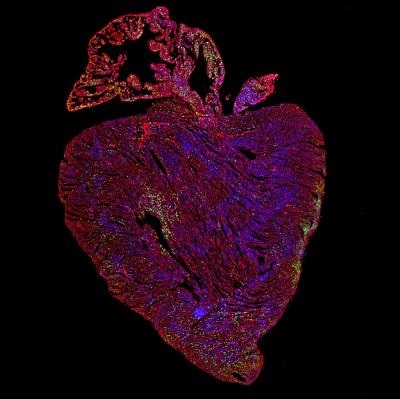
“When these two genes were overexpressed together in the heart muscle cells of adult mice we saw extensive cell replication, leading to a large increase in the number of heart muscle cells,” Wilson explains.
As the world’s population grows and the prevalence of heart failure increases, the cost of patient care is anticipated to increase dramatically. The researchers hope to develop their finding into a genetic therapy for the treatment of heart disease. “We want to use short-term, switchable technologies to turn on Myc and Cyclin T1 in the heart,” Wilson says. “That way we won’t leave any genetic footprint that might inadvertently lead to cancer formation.”
Image: Adult mouse heart after activation of both proteins vital for cell replication. Green shows cells replicating. Image courtesy of Cathy Wilson, University of Cambridge.