Hokkaido University researchers have applied a new approach to gain insight into the synthesis and functions of the lipids found in tears. Their findings, published in the journal eLife, could help the search for new treatments for dry eye disease.
The film of tears covering the eye’s surface is vital for eliminating foreign objects, providing oxygen and nutrients to the eye’s outer tissues, and reducing friction with the eyelid. The film is formed of an outer lipid layer and an inner liquid layer. The outer lipid layer, which is itself formed of two sublayers, prevents water evaporation from the liquid layer. Dry eye disease develops when the glands that produce these lipids dysfunction. However, it has remained unclear how those generally incompatible layers—water and lipid—can form and maintain tear films.
A subclass of lipids called OAHFAs ((O-Acyl)-ω-hydroxy fatty acids) are present in the inner lipid sublayer just above the liquid layer of the tear film. These OAHFAs have both polar and non-polar ends, giving them affinity for both water and lipid. In order to study their function in mice, the researchers wanted to turn off a gene called Cyp4f39, which is known for its involvement in ω-hydroxy fatty acid synthesis. However, previous attempts to turn off Cyp4f39 in mice have led to neonatal death, as the gene plays a vital role in skin. However, for this study, the team used a method that allowed them to turn off the gene in all tissues except the skin.
Search Antibodies Search Now Use our Antibody Search Tool to find the right antibody for your research. Filter
by Type, Application, Reactivity, Host, Clonality, Conjugate/Tag, and Isotype.
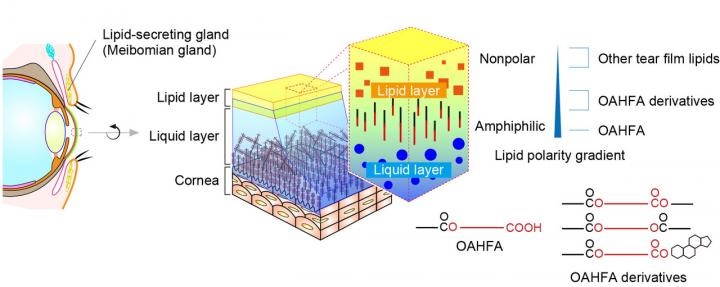
Without Cyp4f39, mice were found to have damaged corneas and unstable tear films, both indicative of dry eyes. Further analyses showed that these mice were lacking OAHFAs and their derivatives in their tear films. Interestingly, the scientists also discovered that the OAHFA derivatives have polarities intermediate between OAHFAs and other lipids in the tear film. This strongly suggests that those lipids together form a polarity gradient that plays an important role in connecting the tear film’s inner liquid layer and outer lipid layer, helping the film spread uniformly over the surface of the eye.
“Drugs currently used in dry eye disease target the liquid layer of the tear film, but there aren’t any drugs that target its lipid layer,” says senior author Akio Kihara. “Since most cases of dry eye disease are caused by abnormalities in the lipid layer, eye drops containing OAHFAs and their derivatives could be an effective treatment.”
Further studies are required to fully understand the functions and synthesis of OAHFAs.
Image: OAHFA, OAHFA derivatives, and other lipids together form a polarity gradient that plays an important role in connecting the lipid layer and liquid layer of the tear film. Image courtesy of Hokkaido University.