Cellular damage can disrupt the energy supply of the cell, which can result in serious consequences for the entire organism. However, a study published today in Nature Communications has shown that the cell can protect itself from functional losses when this happens by repairing itself in a kind of workshop mode.
Mitochondria are known as the “powerhouse” of the cell. They convert chemical energy from the food we eat into energy that the cell can use. Their molecular machinery consists of five components, the so-called complexes I–V.
“In our most recent work, we have discovered a rescue route that enables cells to repair damage of a particularly sensitive part of complex I,” says senior author Aleksandra Trifunovic. “Repairing something is a far more energy-efficient self-help mechanism compared to the effort that would be required to completely destroy and rebuild this entire complex.”
Search Antibodies Search Now Use our Antibody Search Tool to find the right antibody for your research. Filter
by Type, Application, Reactivity, Host, Clonality, Conjugate/Tag, and Isotype.
The specific rescue route Trifunovic identified also acts as a safety valve for the cell. If the rescue route becomes active, the dysfunctional component quickly switches to a shutdown mode and “goes to the workshop.” This way, the cells prevent harmful reactive oxygen species from being produced and released in the powerhouse engine.
“So far, very little is known about how this machinery is maintained and regulated,” Trifunovic says. “Our results shed light on this process and allow us to explore further therapeutic possibilities.”
Apart from the general novelty of the entire mechanism, Trifunovic was particularly surprised to see that it is often better for the organism to keep some powerhouse machine components running despite damage rather than putting all damaged components into “workshop mode” at the same time. This could be because the individual machine components have functions that go beyond energy supply. In the future, Trifunovic would like to further investigate the scope and versatility of this molecular repair pathway in order to identify its full potential for possible therapies.
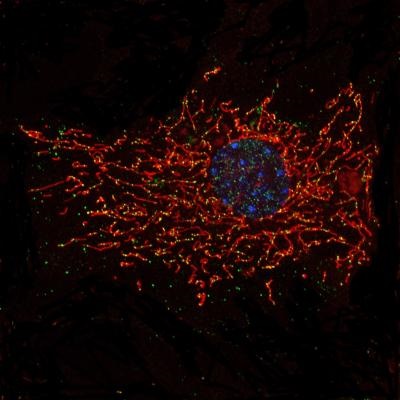
Image: The cell nucleus is blue, the mitochondria structure red, and the mitochondrial DNA green. Image courtesy of Alexandra Kukat.