Research published this week in eLife shows that the immune system of older mice can be given a helping hand by applying immunology expertise and some genital wart treatment. Mice and humans show similar age-dependent changes in their immune systems, so this finding could be applied to increase the robustness of vaccination response in the older population. But don’t try this at home just yet!
As we age, the function of our immune system declines, rendering us more susceptible to infections and less able to generate protective immunity after vaccination. By understanding the cellular and molecular mechanisms that underpin this poor response in older individuals, the researchers repurposed an existing treatment for genital warts to overcome age-related effects on two immune cell types.
“The current coronavirus pandemic highlights that older members of our families and communities are more susceptible to the morbidity and mortality associated with infectious diseases,” says senior author Michelle Linterman of Cambridge. “Therefore, it is imperative that we understand how the immune system in older people works and to explore how we might be able to boost their immune responses to vaccines to ensure they work well in this vulnerable part of our society.”
Coronavirus Research ProductsSearch Now Find the right products for your coronavirus-related research. Biocompare's Coronavirus Research Products category includes commercially available antibodies, ELISA kits, proteins, strains, and PCR assays. Vaccines work by stimulating the immune system to generate antibodies against a specific pathogen. Antibody-secreting cells are produced in the germinal center—an immune reaction hub that forms after infection or vaccination. With age, the magnitude and quality of the germinal center reaction declines.
Immune cells called T follicular helper cells are essential to the germinal center response. In this study, the team investigated why T follicular helper cell numbers decline with age and whether there is a way to boost them upon vaccination.
“The germinal center response is a highly collaborative process that requires multiple cell types to interact at the right place and the right time,” Linterman explains. “Therefore, it made sense to us that defects in one or more of these cell types could explain the poor germinal center response observed in older individuals after vaccination.”
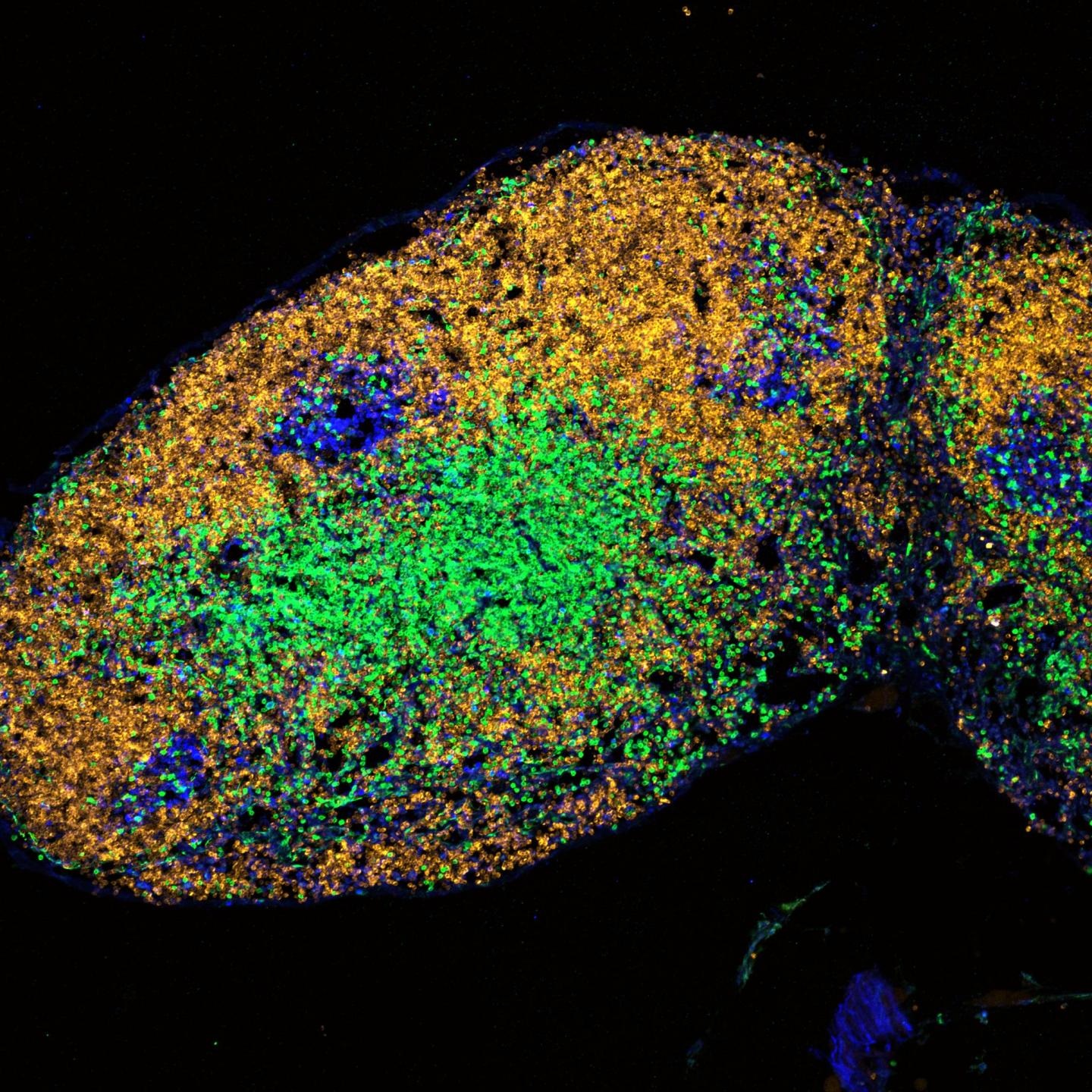
The researchers found that older individuals form fewer T follicular helper cells after vaccination, which is linked with a poor germinal center response and antibody response. By using a genital wart cream on the site of immunization to boost the number of stimulatory cells, the team restored the formation of T follicular helper cells and rescued the age-dependent defects in dendritic cells. Thus, the age-related defects in T follicular helper cells are not irreversible; they can be overcome therapeutically.
Image: A mouse lymph node from young mouse fourteen days after immunization. B cell follicles are shown in yellow (IgD) and proliferating germinal center cells (Blue, Ki67) are shown within the B cell follicle. T cells are shown in green. Image courtesy of the Babraham Institute.