Much remains unknown about how SARS-CoV-2, the virus that causes COVID-19, spreads through the environment. A major reason for this is that the behaviors and traits of viruses are highly variable—some spread more easily through water, others through air; some are wrapped in layers of fatty molecules that help them avoid their host's immune system, while others are "naked."
A recently published viewpoint in Environmental Science & Technology calls for a broader, long-term, and more quantitative approach to understanding viruses, such as SARS-CoV-2, that are spread through the environment.
Scientists and medical experts don't have a good understanding of what virus characteristics and environmental factors control virus persistence in the environment—for example, in aerosols and droplets, on surfaces including skin and in water including seawater, according to the co-authors of the article Krista Wigginton and Alexandria Boehm. "When a new virus emerges and poses a risk to human health, we don't have a good way of predicting how it will behave in the environment," Boehm explained.
Coronavirus Research ProductsSearch Now Find the right products for your coronavirus-related research. Biocompare's Coronavirus Research Products category includes commercially available antibodies, ELISA kits, proteins, strains, and PCR assays.
Part of the problem is historically there has been limited funding for this sort of work. The NIH historically hasn't funded work on pathogens in the environment, and funding at the NSF for this work is limited. Also, coronaviruses and most of the emerging viruses that have caught the world's attention over the last decade are enveloped viruses that are wrapped in an outer layer of fatty lipid molecules that they've stolen from their hosts. Proteins on the surface of the envelopes can help these viruses evade the immune systems of the organisms they are infecting. "There has been much more work on the fate of non-enveloped or naked viruses because most intestinal pathogens in excrement are nonenveloped viruses—like norovirus and rotavirus," said Wigginton.
In their paper, Boem and Wigginton address potential threats that viruses such as SARS-CoV-2 pose to water sources. We usually only worry about viruses in water if they are excreted by humans in their feces and urine. Most enveloped viruses aren't excreted in feces or urine, so they aren't usually on our minds when it comes to our water sources. There is increasing evidence that the SARS-CoV-2 viruses, or at least their genomes, are excreted in feces. If infective viruses are excreted, then fecal exposure could be a route of transmission, according to Boehm, who added, "It's unlikely this could be a major transmission route, but a person could potentially be exposed by interacting with water contaminated with untreated fecal matter."
Drinking water treatment systems have numerous treatment barriers to remove the most prevalent viruses and the most difficult-to-remove viruses, according to the engineers. Research on viruses similar to the SARS-CoV-2 virus suggests they are susceptible to these treatments. "In terms of virus concentration and persistence, this isn't a worst-case scenario," Wigginton said.
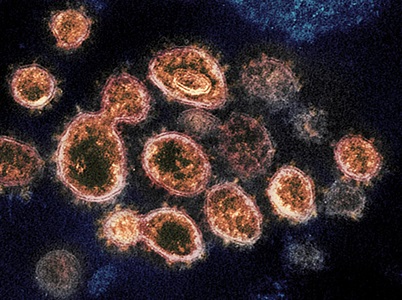
Image: A transmission electron microscope image of SARS-CoV-2, the virus that causes COVID-19.