The signaling molecule IL-2 has long been known to have powerful effects on the immune system, but efforts to harness it for therapeutic purposes have been hampered by serious side effects. Now researchers have worked out the details of IL-2’s complex interactions with receptor molecules on immune cells, providing a blueprint for the development of more targeted therapies for treating cancer or autoimmune diseases. The study was published today in PNAS.
IL-2 acts as a growth factor to stimulate the expansion of T cell populations during an immune response. Different types of T cells play different roles, and IL-2 can stimulate both effector T cells, which lead the immune system’s attack on specific antigens, and regulatory T cells, which serve to rein in the immune system after the threat is gone.
“IL-2 can act as either a throttle or a brake on the immune response in different contexts,” says senior author Nikolaos Sgourakis of UC Santa Cruz. “Our investigation used detailed biophysical methods to show how it does this.”
Search Antibodies Search Now Use our Antibody Search Tool to find the right antibody for your research. Filter
by Type, Application, Reactivity, Host, Clonality, Conjugate/Tag, and Isotype.
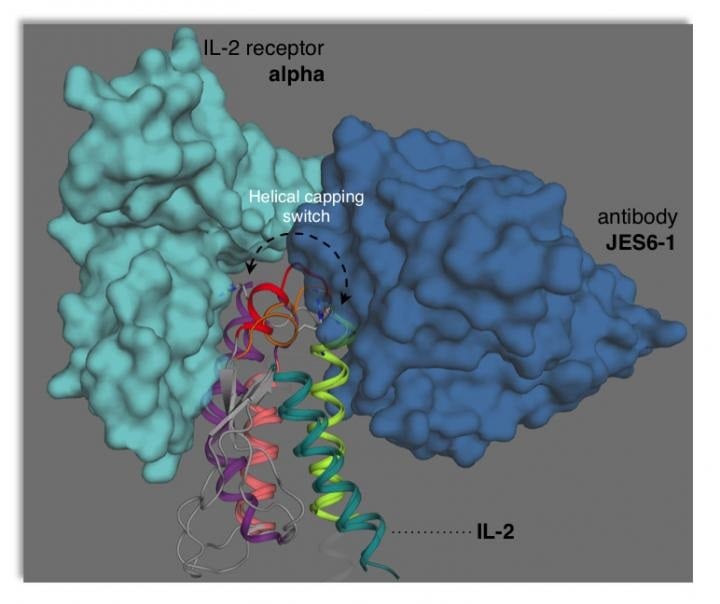
According to the study, IL-2 adopts two different conformations that affect how it interacts with the receptors on different types of T cells. In solution, IL-2 naturally shifts back and forth between a minor conformation and a major conformation. Additionally, certain mutations or interactions with other molecules can bias IL-2 toward adopting one conformation or the other.
“We have now come one step closer to a detailed understanding of how the IL-2 cytokine works,” says first author Viviane de Paula. “With the use of NMR, we were able to describe the structure, dynamics, and function of IL-2 in its two conformations.”
The study opens up numerous possibilities for designing drugs to stabilize IL-2 in a particular conformation for therapeutic applications.
“We can use this information to tweak the balance, depending on what we want to achieve in a clinical setting,” Sgourakis says. “To target regulatory T cells, we would want to stabilize the minor conformation, and to target effector T cells, we would want to stabilize the major conformation.”
Image: This illustration depicts how IL-2 adopts two different conformations that are "primed" for interactions with the JES6-1 antibody or the IL-2 receptor on T cells. This dynamical switching can be tuned to either boost or block immune responses depending on the desired therapeutic application. Image courtesy of Viviane De Paula.