Males that face tougher competition for fertilization risk having offspring with a greater number of harmful mutations in their genome than males without rivals, according to an Uppsala University study in the beetle species Callosobruchus maculatus. The study was published today in Nature Ecology & Evolution.
Just as with fish, birds, and mammals, in the insect world, several males often mate with the same female. This leads to a form of sexual selection in which the males’ sperm compete to fertilize the female’s eggs. Males that produce more numerous or more competitive sperm often win the competition and become fathers. The new study suggests that this increased competition between males can lead to a higher rate of harmful mutations in offspring.
Genomic DNA is damaged with every cell division but this damage is usually prevented or repaired by an effective, but costly, cellular surveillance system. The new study shows that sperm production in competing males of the species Callosobruchus maculatus, or cowpea weevil, comes at the expense of this cellular surveillance.
Search Antibodies Search Now Use our Antibody Search Tool to find the right antibody for your research. Filter
by Type, Application, Reactivity, Host, Clonality, Conjugate/Tag, and Isotype.
In experiments, male beetles were exposed to radiation in order to damage their genome. After a period of recuperation, the males were allowed to mate with females and become fathers. The researchers then followed their offspring to measure the varying quality of subsequent generations and discovered that males kept in groups, with the concomitant risk of sperm competition, had offspring with a greater number of harmful new mutations than those that lived alone.
The researchers do, however, point out that competition between males need not lead to deteriorating gene health in the long term. This is because, as the study also shows, males from populations with high sperm competition over many generations adapt to the new conditions by producing more sperm and more viable offspring compared to males adapted to a life of monogamy.
“Even if the direct effect of sperm competition is to increase the number of mutations in offspring, the paradoxical long-term effect of sexual selection may be a lower rate of mutation,” says senior author David Berger.
The researchers behind the study explain that both of these mechanisms play important roles in how genetic variation arises and is maintained in species where males compete to mate. This in turn can affect the potential for evolutionary adaptation, which depends on genetic variation.
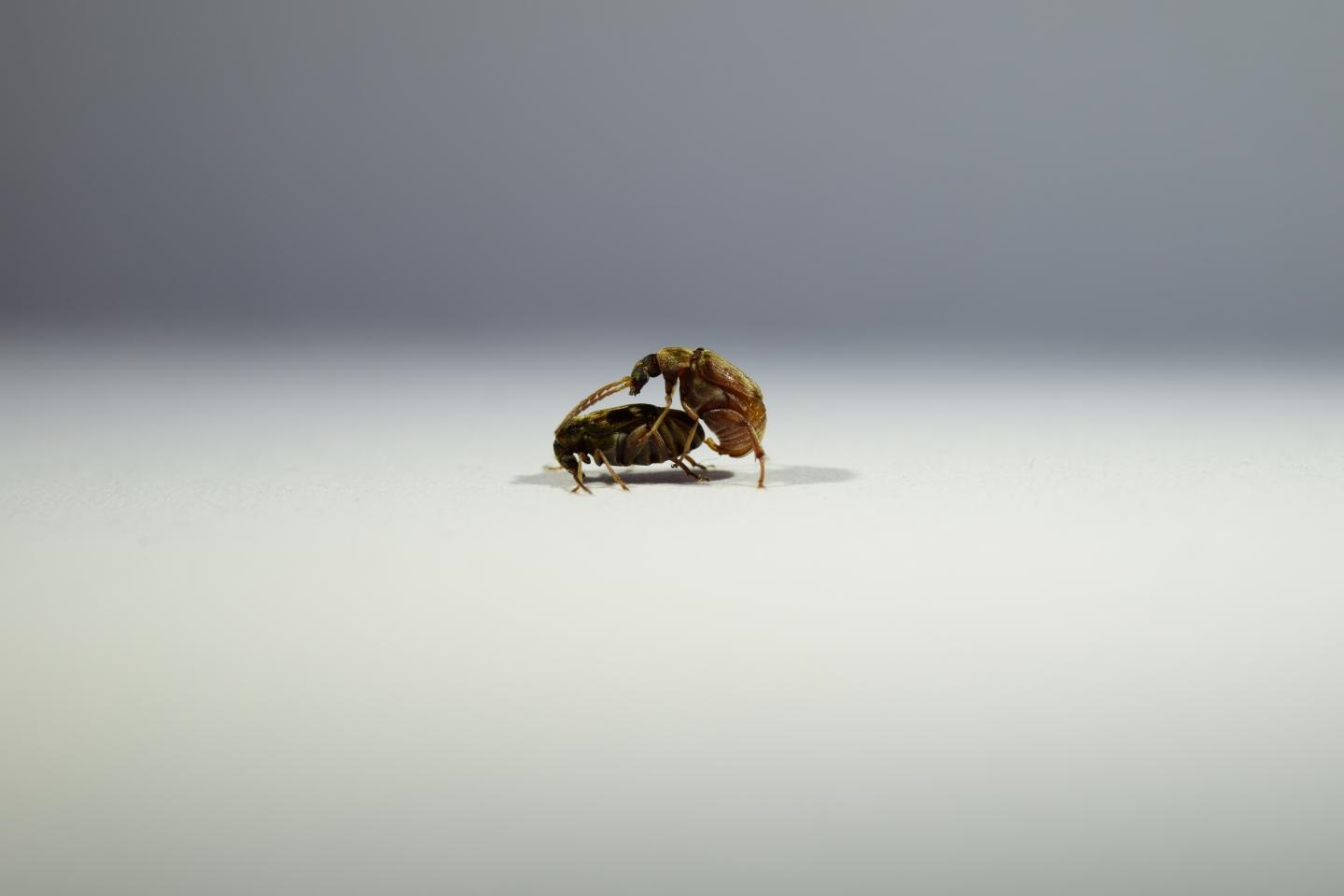
Image: A female (lower left) and male (top right) Callosobruchus maculatus mating. The mating typically lasts for 2-5 minutes during which the male transfers 40,000-60,000 sperm in an ejaculate weighing about 3-5% of his own body weight. Image courtesy of Mareike Koppik.