Tumors have figured out various ways to evade the immune system. Medicine, for its part, has fought back with cancer immunotherapies. The major approach uses checkpoint inhibitors—drugs that help the immune system recognize cancer cells as foreign. Another method, CAR T-cell therapy, directly engineers peoples’ T cells to efficiently recognize cancer cells and kill them.
But not all patients benefit from these approaches, and CAR T-cell therapy carries significant risks. New research from Boston Children’s Hospital, published today in Nature, adds another strategy to the arsenal, one that could potentially work in more types of cancer. The strategy involves reactivating a gene called gasdermin E, harnessing an immune response we already have but that is suppressed in many types of cancer.
“Gasdermin E is a very potent tumor suppressor gene, but in most tumor tissues, it’s either not expressed or it’s mutated,” says senior author Judy Lieberman. “When you reactivate gasdermin E in a tumor, it can convert an immunologically ‘cold’ tumor—not recognized by the immune system—into a ‘hot’ tumor that the immune system can control.”
Search Antibodies Search Now Use our Antibody Search Tool to find the right antibody for your research. Filter
by Type, Application, Reactivity, Host, Clonality, Conjugate/Tag, and Isotype.
In the study, Lieberman and colleagues showed that 20 of the 22 cancer-associated mutations they tested led to reduced gasdermin E function. When they re-introduced gasdermin E in a mouse model, they were able to trigger pyroptosis and suppress growth of a variety of tumors.
The team also showed, in mouse tumor cell lines, how gasdermin E works. Normally, cell death happens through a process called apoptosis—a quiet, orderly death. But if gasdermin E is present and working, cancer cells go down in flames, through a highly inflammatory form of cell death called pyroptosis that sounds a potent immune alarm. The alarm recruits killer T cells that then suppress the tumor.
Now, the researchers are investigating therapeutic strategies for inducing gasdermin E to rally that anti-tumor immune response. “What we’re suggesting is that if we can turn on the danger signal, which is inflammation, we can activate lymphocytes more fully than with other immunotherapy approaches, and have immunity that is potentially much broader,” says Lieberman. “Combining activation of inflammation in the tumor with approved checkpoint inhibitor drugs could work better than either strategy on its own.”
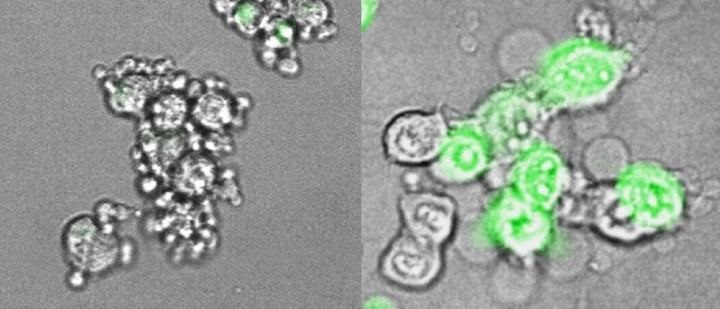
Image: At left, cancer cells from an immunologically cold tumor, in which gasdermin E has been suppressed, undergo a slow, uneventful death. Their outer membrane remains intact and they quietly shrink. The cancer cells at right have had gasdermin E re-introduced: They blow up, forming giant membrane balloons, and release molecules that trigger inflammation and a protective immune response. Image courtesy of Zhibin Zhang/Lieberman Lab, Boston Children's Hospital.