In a study published today in eLife, researchers from the Technical University of Munich (TUM) and Heidelberg University discovered a mutation in humans that leads to systemic light chain amyloidosis and fatal organ failure.
In response to infection, our bone marrow plasma cells produce antibodies, which typically consist of four amino acid chains: two heavy and two light. Under rare circumstances, plasma cells can multiply excessively, resulting in the overproduction of antibody short chains. The excessive number of antibody short chains results in their associating to fibrils that then deposit in organs, leading to fatal organ failure.
In people suffering from light chain amyloidosis (AL amyloidosis), these light chains are deposited as extremely fine fibers—so-called amyloid fibrils—in tissue or in organs. The disease is often recognized only after the deposits already compromise the function of organs. In many cases, AL amyloidosis is fatal.
Search Antibodies Search Now Use our Antibody Search Tool to find the right antibody for your research. Filter
by Type, Application, Reactivity, Host, Clonality, Conjugate/Tag, and Isotype.
“To date, little was known about the exact cause of this amyloidosis,” says senior author Johannes Buchner, professor of biotechnology at the Technical University of Munich. “Depending on the organ affected, the symptoms vary considerably. Furthermore, each patient produces different types of antibodies. The disease is thus difficult to diagnose at an early stage.”
Using various analytical and database-supported methods, the team of scientists succeeded in identifying eleven mutations caused by the disease in the antibodies of a patient with advanced AL amyloidosis.
Further investigations showed that exactly one mutation was responsible for the destabilization and formation of the disease-causing amyloid fibrils. This mutation causes the unstable light chain to lose its structure after breaking into fragments, which then form the deadly amyloid fibrils.
“Our study shows that mutations that lead to unstable light chains are an important factor in the occurrence of amyloidosis,” says first author Pamina Kazman, who carried out the majority of the measurements. “In the long term, we hope that these and other studies will lead to new, earlier diagnostic methods and possibly even new treatment options.”
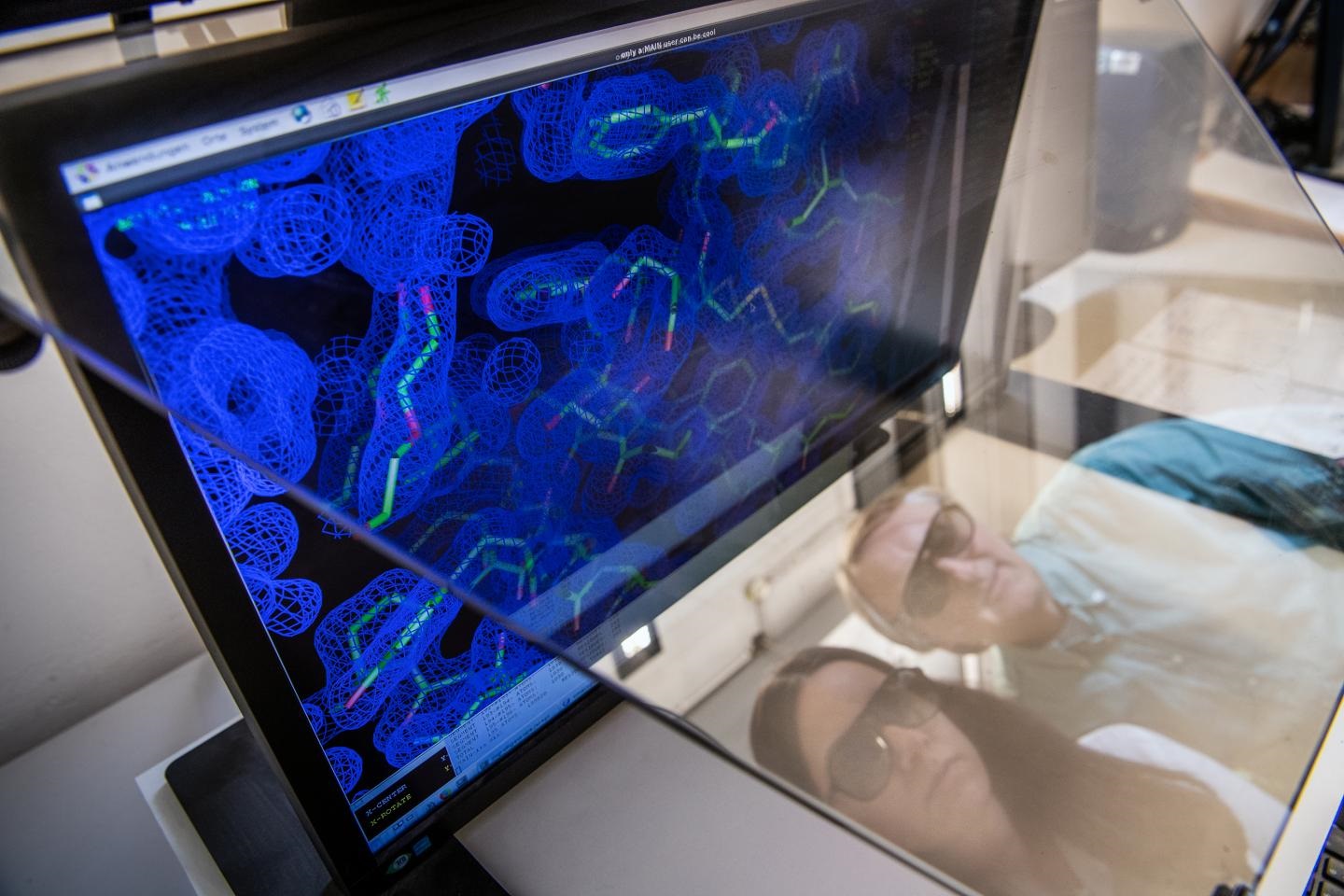
Image: Ph.D. student Pamina Kazman and Johannes Buchner, professor for biotechnology at the Technical University of Munich, look at the crystal structure of an antibody domain on a computer monitor. Image courtesy of Andreas Heddergott / TUM.