For years, the scientific literature has been pointing to connections between energy-dense food, obesity, and compulsive food intake bordering addiction. Now, in a study published today in Cell Metabolism, researchers from the CNRS and Université de Paris have shown how fatty nutrients act on the brain in the reward circuit. The results of the study shed new light on the connection between food and eating disorders.
This recent work shows that triglycerides—the nutrients that constitute animal fats, vegetable oils, and dairy products—interact with certain neurons in the reward circuit and reduce their excitability in mice, both in vitro and in vivo. These neurons carry a specific type of dopamine receptor, and their activity strengthens reward-seeking behavior. The scientists also observed that the manipulation of triglyceride levels in mouse brains changes many behaviors associated with dopamine, like pleasure and the motivation to collect food.
Search Antibodies Search Now Use our Antibody Search Tool to find the right antibody for your research. Filter
by Type, Application, Reactivity, Host, Clonality, Conjugate/Tag, and Isotype.
For the study, researchers compared a person’s brain activity in response to a food odor with the person’s blood triglyceride level after a meal. They showed that activity in the prefrontal cortex—one of the regions of the reward circuit that makes connections between a food’s odor, its taste, and the pleasure that it causes—is directly correlated with the quantity of triglycerides circulating in the blood. The higher the quantity of triglycerides, the lower the prefrontal cortex’s response to a food odor. This suggests that the activity of important brain structures in the reward system can be directly modified by a lipid nutrient.
Usually, triglycerides only circulate in the blood after a meal. However, in obese patients, doctors often observe abnormally high triglyceride levels all day long. In this context, the study offers a new framework for potentially explaining why ever-wider access to rich foods may contribute to the establishment of compulsive dietary problems and increasing obesity rates.
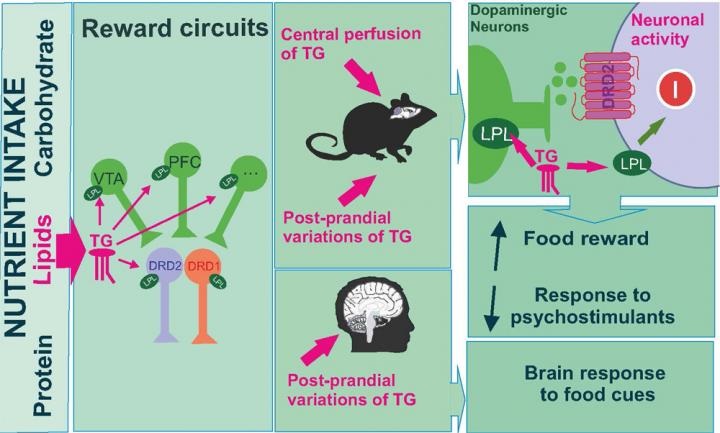
Image: Food is a source of various circulating nutrients, including triglycerides, which are the postprandial (i.e., after a meal) lipid source. Triglycerides can enter the brain, where they act directly on the neurons that release or respond to dopamine. This mechanism is lipoprotein lipase-mediated triglyceride hydrolysis and is translated by inhibition of these neurons in the reward system. In rodents, when triglycerides act on neurons in the reward system, it affects dopamine-dependent behaviors (pleasure from eating, response to psychostimulants, etc.). In humans, postprandial triglyceride variations are narrowly correlated with the way the brain perceives and responds to a dietary stimulus. Image courtesy of Chloe Berland et al.