Dinucleoside polyphosphates are small signaling molecules that are found in all types of organisms. They are often called “alarmones,” as their concentration in cells increases under stress conditions (alarm). These molecules influence various cellular functions, but the mechanism of their action was previously unknown. In a study published today in Nature Communications, researchers discovered a new class of alarmone and described its mechanism of action.
Initially, the researchers noticed a similarity between the structure of alarmones and the structure of RNA, so they presumed that the alarmones could serve as RNA caps. Using mass spectrometry, they detected nine new types of these structures and showed them as a part of RNA.
“As chemists, we noticed the glaring similarities of these alarmones with the RNA structure, so we were able to discover something that has been hidden from biologists for fifty years,” says senior author Hana Cahová of IOCB Prague.
Search Antibodies Search Now Use our Antibody Search Tool to find the right antibody for your research. Filter
by Type, Application, Reactivity, Host, Clonality, Conjugate/Tag, and Isotype.
The researchers found that these molecules are accepted by RNA polymerases and used as the first building blocks in RNA synthesis. Moreover, they determined that dinucleoside polyphosphate–capped RNA can be cleaved by two types of enzymes and thus degraded. Some of the dinucleoside polyphosphate RNA caps were methylated, and the researchers have shown that these methylations protected RNA from cleavage and further degradation.
The amount of dinucleoside polyphosphate–capped RNAs significantly increased under starvation conditions. Therefore, the authors propose that these caps protect RNA from degradation under starvation conditions when the cells do not have enough building blocks for creating such macromolecules as RNA. In such situations, the cell cannot flexibly react to the demands of the environment, but it can retain at least some RNA. Once the cell has enough nutrition again, the capped RNA is degraded by a specific enzyme, and the cell can build new RNA to reflect the current situation.
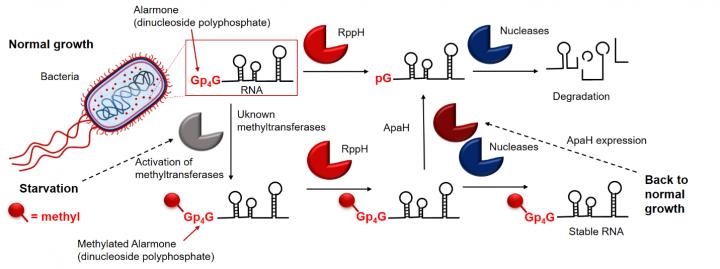
This is the first work showing that the 5’ end status of RNA depends on environment and stress. Moreover, the discovery of alarmones in RNA can explain the mechanism of their action. This work also provides the first evidence of small signaling molecules—dinucleoside polyphosphates—acting as parts of the RNA.
Image: Graphical abstract. Image courtesy of Hudeček, O., Benoni, R., Reyes-Gutierrez, P.E. et al.