Scientists from Trinity College Dublin have made an important discovery with implications for those living with the common, debilitating eye disease called age-related macular degeneration (AMD). The researchers discovered that the molecule TLR2, which recognizes chemical patterns associated with infection in the body, also seems to play an important role in the development of retinal degeneration. Their research was published Tuesday in Cell Reports.
AMD is the most common form of central visual blindness in adults. People with AMD may have difficulty recognizing faces, reading, watching television, and driving as their central retina degenerates. Aging is the greatest risk factor for development of AMD, with one in four people over the age of 75 living with the condition. Still, no pharmaceutical interventions are available to prevent the progression of the disease.
“The lack of approved therapies for AMD is mainly because the factors involved in triggering the disease are not very well understood,” says senior author Sarah Doyle. “Understanding and identifying early molecular events that may trigger dry AMD will allow us to develop a more targeted approach to therapy. In this case, we believe that regulating the activity of TLR2 may, over time, help to prevent the progression of dry AMD.”
Search Antibodies Search Now Use our Antibody Search Tool to find the right antibody for your research. Filter
by Type, Application, Reactivity, Host, Clonality, Conjugate/Tag, and Isotype.
Two biological processes involved in AMD are (1) the uncontrolled oxidative stress that results in the formation of bleach-like chemicals in the retina and (2) the laying down of a protein called complement that tags whatever it touches for elimination.
In this study, the scientists implicated TLR2 as a critical bridge between oxidative damage and complement-mediated retinal degeneration. TLR2, which is found on the surface of cells, is known to sense infection by recognizing chemical signals found on microorganisms. Once TLR2 is activated, it triggers a signal cascade resulting in an inflammatory response.
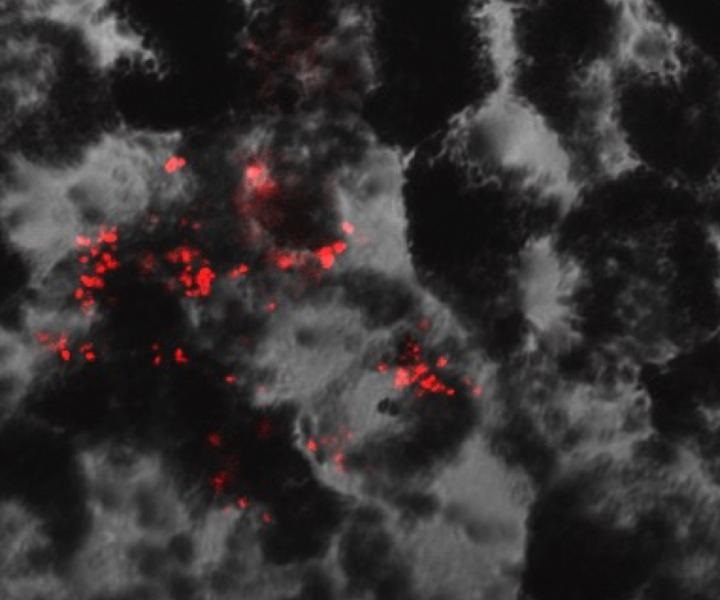
“A function for TLR2 has not previously been reported in retinal neurodegenerative disease pathology, but it is likely to play an important role because when we remove TLR2 from our experimental model systems we reduce the level of complement, and this has the effect of protecting cells that are essential for vision from dying,” Doyle says. “With the continual increase in life expectancy outpacing the rate at which drugs for age-related conditions are developed, new avenues of therapy are badly needed, so the fact that blocking this single protein can have such a protective effect in the eye is a particularly exciting discovery.”
Image: The honeycomb structure of human retinal pigment epithelial (RPE) cells with oxidative stress-induced complement (C5b-C9) in red. Image courtesy of Dr. Sarah Doyle, Trinity College Dublin.