The long-term storage of cells at super-cold cryogenic conditions often results in the formation and growth of ice, which can pierce and tear apart cells. New research aims to facilitate the design of efficient polymers that can prevent the growth of ice that damages cells.
Cell-based therapeutics demand the development of potent inhibitors of ice recrystallization that can compete in activity with natural antifreeze glycoproteins but do not have the cost and toxicity of dimethyl sulfoxide. This demand has propelled the synthesis of polymers that mimic the action of antifreeze glycoproteins. But the most potent synthetic ice recrystallization inhibitor found to date, polyvinyl alcohol (PVA), is orders of magnitude less potent than natural glycoproteins.
"Efforts to identify stronger inhibitors for ice growth seem to have stalled, as there is not yet a molecular understanding of the factors that limit the ice recrystallization inhibition efficiency of polymers," explains Valeria Molinero, co-author of a paper published yesterday in the Journal of the American Chemical Society.
Search Antibodies Search Now Use our Antibody Search Tool to find the right antibody for your research. Filter
by Type, Application, Reactivity, Host, Clonality, Conjugate/Tag, and Isotype.
The University of Utah team used large-scale molecular simulations to elucidate the molecular underpinnings of how flexibility, length, and functionalization of polymers control their binding to ice and their efficiency to prevent ice growth. Their study shows that the bound time of the molecules at the ice surface is controlled by the strength of their ice binding coupled with the length of the polymer and how fast they propagate on the ice surface.
"We found that the efficiency of flexible polymers in halting ice growth is limited by the slow propagation of their binding to ice," Molinero says.
The study dissects the various factors that control the binding of flexible polymers to ice and that account for the gap in potency of PVA and natural antifreeze glycoproteins. In a nutshell, each block of antifreeze glycoproteins binds more strongly to ice than PVA does, and are also favored by their secondary molecular structure that segregates the binding and non-binding blocks to allow them to attach faster to ice to stop its growth.
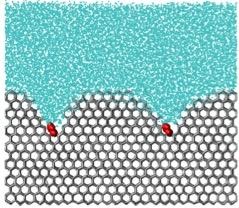
"To our knowledge, this work is first to identity the time of propagation of binding as a key variable in the design of efficient ice-binding flexible polymers," first author Pavithra Naullage says. "Our study sets the stage for the de novo design of flexible polymers that can meet or even surpass the efficiency of antifreeze glycoproteins and make an impact in biomedical research."
Image: A simulation of an ice-inhibiting molecule. The molecule, in red, is like a weight on the surface of the ice crystal, curving it and preventing further ice crystal growth. Image courtesy of the University of Utah.