Everything a cell does, from division to migration, is controlled by enzymes that chemically modify other proteins in the cell. Researchers at Princeton University have devised a new mathematical technique to describe the behavior of many such enzymes. Published today in Current Biology, the approach will help researchers determine how genetic mutations in these enzymes cause a range of human diseases.
Enzymes called kinases alter protein activity by adding phosphate molecules to them, sometimes at multiple sites. However, studying these “multisite phosphorylation reactions” is complicated because the phosphate groups can be added rapidly and in different orders, which may affect how the modified proteins behave within the cell.
In the new study, Princeton Researchers developed a mathematical model of how a kinase called MEK adds two phosphate molecules to a kinase called ERK. This double phosphorylation activates ERK so that it can drive numerous cellular processes, including cell growth and division. Mutations in MEK and ERK can cause several diseases, including cancer.
Search Antibodies Search Now Use our Antibody Search Tool to find the right antibody for your research. Filter
by Type, Application, Reactivity, Host, Clonality, Conjugate/Tag, and Isotype.
“There are many mutations in MEK that affect the overall levels of dually phosphorylated ERK,” says senior author Martin Wühr. “But the effects of these mutations on the mechanism of ERK activation remain unknown.”
The researchers’ model revealed how fast each phosphate group is added and how often both phosphates are added by the same enzyme. Most of the time, a single MEK enzyme binds to ERK and adds one phosphate molecule before it detaches and allows a second MEK enzyme to bind and add the second phosphate.
The researchers then used their model to analyze a mutant version of MEK that is found in human cancers. This mutant MEK was twice as fast at adding the first phosphate to ERK, and it was much more likely to remain attached and add the second phosphate group itself. Together, this enhances ERK activation and accelerates cancer cell growth.
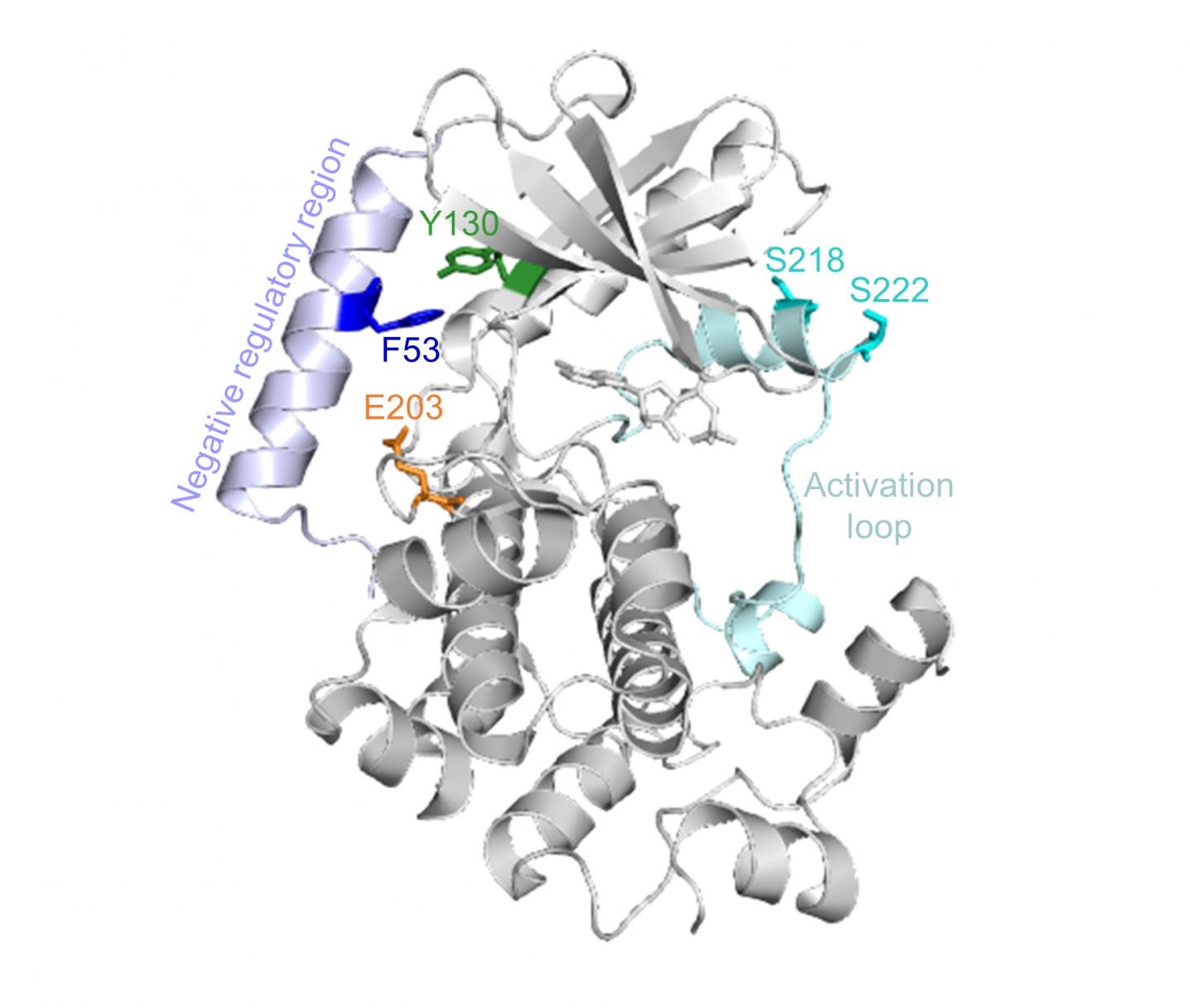
The researchers then analyzed two other MEK mutations that cause a variety of developmental abnormalities, including congenital heart defects and stunted growth. These mutations did not affect MEK’s ability to add phosphate molecules to ERK. Instead, they enhance the activation of MEK by another kinase, called Raf, which adds two phosphate molecules onto MEK.
“We expect that our mathematical models will allow a deeper, more quantitative understanding of cell regulation systems, including their responses to mutations of constituent proteins,” says coauthor Stanislav Shvartsman.
Image: A ribbon diagram shows the structure of the enzyme MEK and the position of three mutations (called F53, Y130, and E203) that cause disease. Image courtesy of Eyan Yeung and Martin Wühr, Princeton University.