Many people consult their friends before making big decisions. And according to a new study, in response to infection, human immune cells do the same thing. The results were published today in Nature Communications and could lead to new therapies to treat chronic autoimmune diseases or to mobilize the immune system to help fight cancer.
“This is a previously unrecognized aspect of immune function,” says senior author Joshua Leonard of Northwestern. “The cells make a coordinated decision. They don’t uniformly activate but instead collectively decide how many cells will activate, so that together, the system can fend off a threat without dangerously overreacting.”
The body’s immune system is constantly working to maintain a delicate balance. When a threat is introduced, the system needs to respond strongly enough to fight off infection or disease but not so strongly that it causes harm.
Search Antibodies Search Now Use our Antibody Search Tool to find the right antibody for your research. Filter
by Type, Application, Reactivity, Host, Clonality, Conjugate/Tag, and Isotype.
“When it comes to immune responses, it’s the difference between life and death,” Leonard explains. “If your body over-responds to a bacterial infection, then you could die from septic shock. If your body doesn’t respond enough, then you could die from rampant infection. Staying healthy requires the body to strike a balance between these extremes.”
The new study was about better understanding how the immune system makes these types of decisions.
“It’s especially interesting because the immune system is decentralized,” says first author Joseph Muldoon of Northwestern. “Immune cells are individual agents that need to work together, and nature has come up with a solution for how they can get on the same page. Cells arrive at different activation states, but in such a way that, on the whole, the population response is calibrated.”
To explore this phenomenon, the researchers examined macrophages, a type of immune cell that is part of the first line of defense for combatting infection and disease. They observed how macrophages responded to a bacterial chemical using techniques that enabled the researchers to watch individual cells’ responses over time. They then used computational models to help interpret and explain these observations.
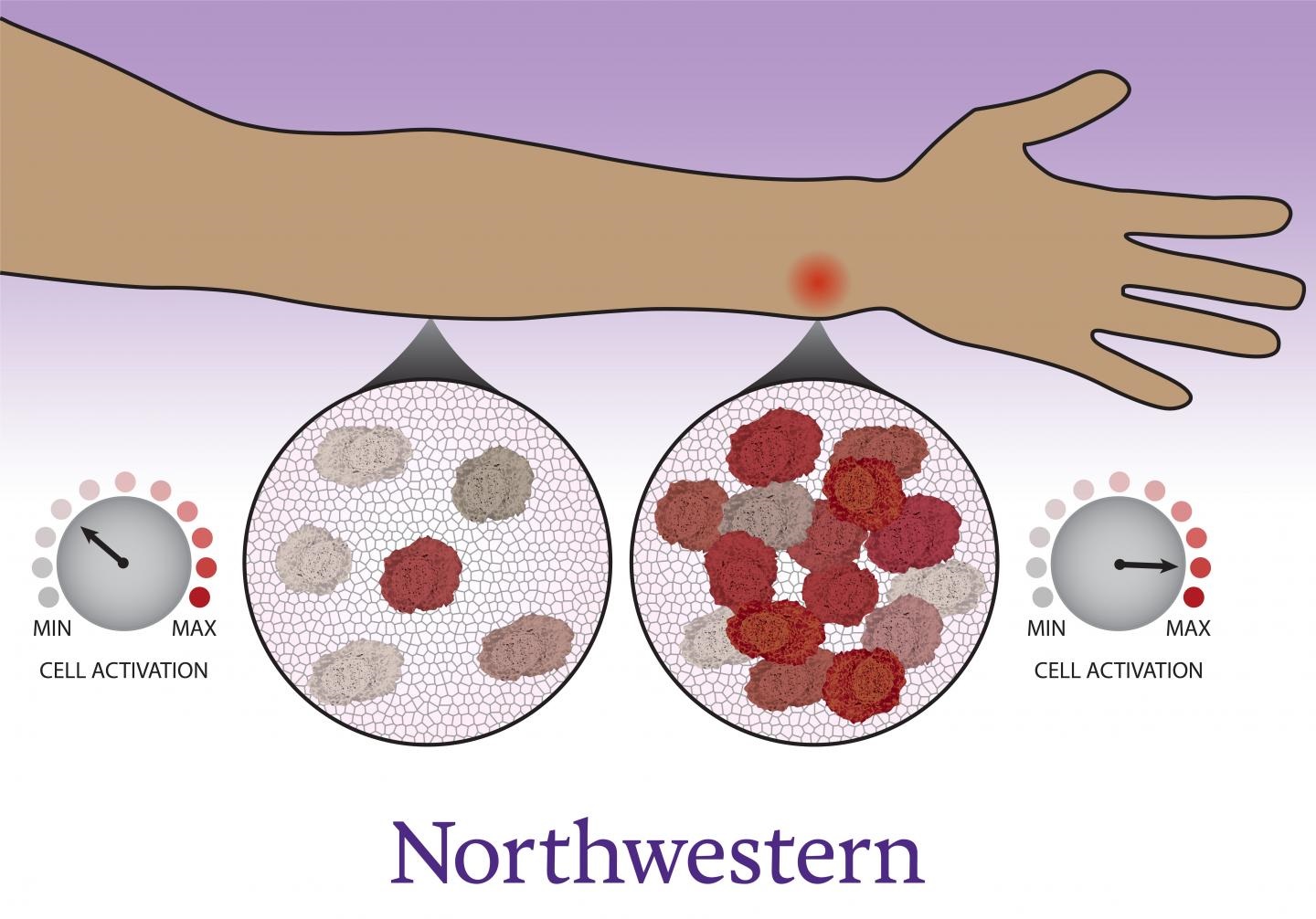
“Over time, the cells observe their surroundings to get a sense of their neighbors,” Muldoon says. “Each cell becomes poised to respond as a high activator or not. Now that we know there’s this additional layer controlling the immune system, it opens up a whole avenue to study whether there are new targets for immunomodulation.”
Image: After migrating to a site to possible infection, immune cells count each other in order to decide whether to kick into high gear. Image courtesy of Northwestern University.