It’s no surprise that the bacterial microbiome on the surface of the skin is unique to each person. However, in a study published yesterday in mBio, University of Copenhagen researchers found that the bacteria found in the dermis is the same for all people regardless of age and gender. The researchers hope their work will lead to better treatment and understanding of skin disorders like eczema and psoriasis.
“It is important that we drop the assumption that we are all different, and that the microbiome of the skin does not matter very much. We do know that bacteria play a major role in skin disorders. Therefore, we need to understand the bacteria and the skin in its three dimensions,” says senior author Thomas Bjarnsholt. “Especially in connection with skin disorders, you see that the healthy skin balance disappears and that there is a build-up of some dominant bacterial species. Hopefully, this knowledge will help us to understand for example how eczema occurs and which irregularities are taking place in the skin.”
Search Antibodies Search Now Use our Antibody Search Tool to find the right antibody for your research. Filter
by Type, Application, Reactivity, Host, Clonality, Conjugate/Tag, and Isotype.
The understanding of the dermis microbiome may also be important to understand how, for example, acute wounds, infections, and surgical wounds occur.
“We believe that the dermis’s microbiome has a bearing on the risk of infection after surgery,” says first author Lene Bay. “When you cut through the skin during surgery, you may be pushing some of these bacteria even further down. And the underlying bacteria are not cleansed with surgical ethanol like the bacteria on epidermis. Which significance that may have and whether it may be the cause of post-surgery infections is one of the things that we need to study more closely.”
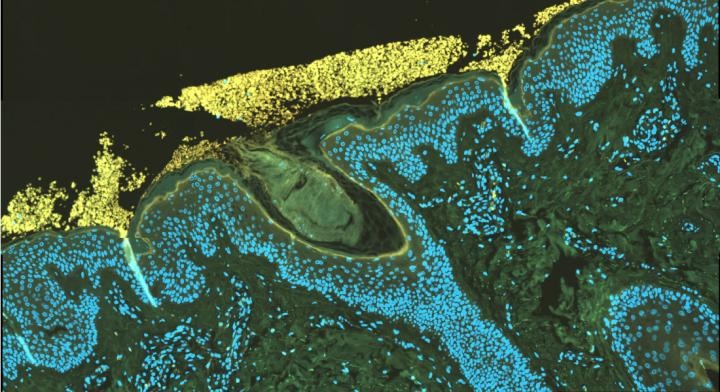
In the present study, the researchers looked at skin from the knees and hips, which are so-called “dry skin areas.” Their next step will be to study skin from oily and moist areas—for example, the upper back and the armpit, respectively. In the long term, the researchers would also like to study skin samples from diseased patients in order to compare the dermis microbiome between healthy and diseased individuals.
Image: A cross-section of human skin. Image courtesy of Lene Bay, the Faculty of Health and Medical Sciences, University of Copenhagen.